Home › Dive Sites › Indonesia › Lombok › Shallow Turbo

Shallow Turbo

📍 Lombok, Indonesia

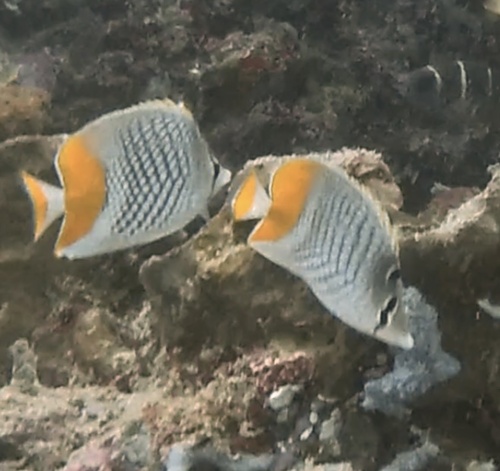
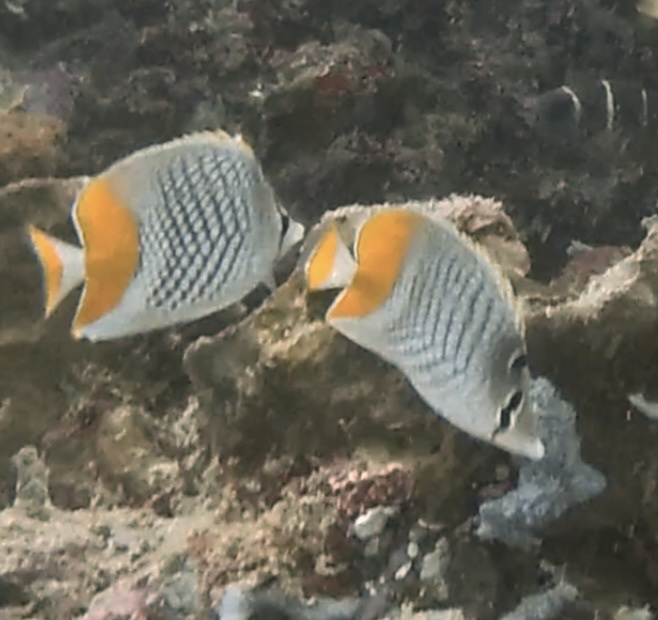
Crosshatch Butterflyfish (Chaetodon xanthurus) — recorded at Shallow Turbo

Shallow Turbo is a dive site in Lombok, Indonesia. It lies within the Gili Ayer, Gili Meno, Gili Trawangan Marine Recreation Park. Currents typically run at 2.2 km/h and reach 4.1 km/h on the strongest days. Water temperatures range from 28°C in August to 30°C in November. The typical daily tidal range is about 1.2 m. Species recorded in the area include Green Sea Turtle, Crosshatch Butterflyfish, Bluestreak Goby, Lemon Damsel and Doublebar Rabbitfish.

Dive Conditions

💨
Current
2.2 km/h (4.1)
🌡️
Water Temp
28–30 °C

🤿 Book a Diving Tour in Shallow Turbo

Tours powered by GetYourGuide. FindADive may earn a commission on bookings.

Typical Current 2.2 km/h (up to 4.1)
Water Temperature 28–30 °C
Tidal Range 1.2 m (typical daily)
GPS -8.3412°, 116.0458°

Data sources: currents and water temperature from Open-Meteo Marine (CC BY 4.0), hourly model values 2024. Tidal range is the median daily range of modelled sea level from Open-Meteo Marine, hourly values 2024. Protected area boundary from OpenStreetMap contributors (ODbL). Species observations from iNaturalist, checked against the World Register of Marine Species.

Conditions at Shallow Turbo through the year

Sea surface temperature at the site coordinates, averaged per month from hourly model values for 2024. The water is warmest in November at about 30 °C and coolest in August at about 28 °C, a spread of 2.1 degrees across the year.

Monthly sea surface temperature at Shallow Turbo (°C)
JanFebMarAprMayJunJulAugSepOctNovDec
29.5 29.5 29.8 30.2 29.8 29.0 28.7 28.2 28.5 29.2 30.3 30.0

Ocean current at the site runs at a typical 2.2 km/h. In the strongest tenth of the hours modelled for 2024 it reaches 4.1 km/h, which is when entries are normally timed to slack water at the turn of the tide.

The tide moves the water level by a median 1.2 m over a day, and by up to 1.7 m on the largest days of the month. That range drives how much water is exchanged over the reef and when the current turns.

Offshore wave statistics are not shown for Shallow Turbo: within 10 km of the site there is land in the directions from which 84 % of the larger waves in the area arrive, so open-sea values would overstate the swell at the site itself.

Shallow Turbo lies inside Gili Ayer, Gili Meno, Gili Trawangan Marine Recreation Park. Protected areas can carry their own rules on entry fees, permits, anchoring and fishing; check the current rules with a local operator before you dive.

How Shallow Turbo compares

These comparisons use only the measured values above, set against the 376 dive sites published on findadive.com. A percentage shows the share of other sites with a lower (or higher) value, so it reads the same way wherever the site is.

Shallow Turbo compared with all listed sites and with Lombok
MeasureThis siteCompared with all sitesMedian in Lombok
Mean water temperature29.4 °Ccooler than 53 % of the other 375 sites29.4 °C (44 sites)
Water temperature in the coolest month28.2 °Cwarmer than 55 % of the other 375 sites28.2 °C (44 sites)
Typical current2.2 km/hstronger than 68 % of the other 375 sites1.8 km/h (44 sites)
Current in the strongest 10 % of hours4.1 km/hstronger than 70 % of the other 375 sites3.2 km/h (44 sites)
Median daily tidal range1.2 msmaller than 81 % of the other 375 sites1.2 m (44 sites)

Water temperature, current and tide from Open-Meteo Marine (CC BY 4.0), hourly model values for 2024 at -8.3412°, 116.0458°. Protected area boundary from OpenStreetMap contributors (ODbL). Wave statistics from ERA5-Ocean via Open-Meteo Marine (contains modified Copernicus Climate Change Service information 2015–2024), daily maximum wave height on a 0.5° grid; land shelter tested against Natural Earth coastlines.

Marine life recorded at this site

Research-grade observations from iNaturalist within about 12 km of these coordinates.
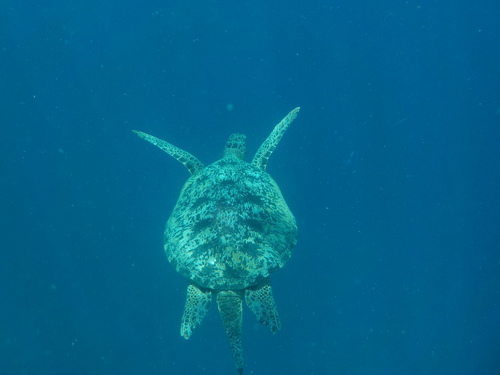
Green Sea Turtle (Chelonia mydas)
Green Sea Turtle Chelonia mydas A large sea turtle with a smooth, heart-shaped carapace, often seen swimming or resting on the seabed.to 1.5 m · surface to 40 m · day and nightseagrass beds, coral reefs, and sandy areasRemain still and avoid sudden movements; the turtle may approach if it feels unthreatened. (c) Jacek Pietruszewski, some rights reserved (CC BY) · observation
Crosshatch Butterflyfish (Chaetodon xanthurus)
Crosshatch Butterflyfish Chaetodon xanthurus A butterflyfish with a white body crossed by a dark grid pattern, a yellow tail and a black eye bar.to 15 cm · 5-30 m · by daycoral-rich areas of clear lagoons and seaward reefsOften seen in pairs; look for the distinctive chequered pattern on its flanks. no rights reserved · CC0 · observation
Bluestreak Goby (Valenciennea strigata)
Bluestreak Goby Valenciennea strigata A slender goby with a pale body and a distinctive electric-blue stripe running from its eye to the tail, often seen sifting mouthfuls of sand.to 15 cm · 1-25 m · by daysandy patches on reef flats and slopesLook for a small, neat mound of excavated sand pellets; the goby will be hovering nearby and darting back to its burrow. no rights reserved · CC0 · observation
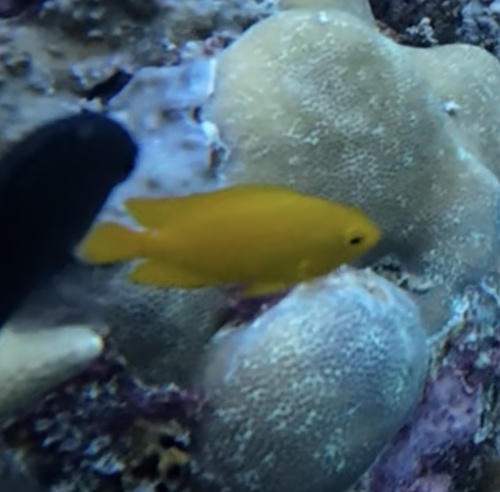
Lemon Damsel (Pomacentrus moluccensis)
Lemon Damsel Pomacentrus moluccensis A small, bright yellow damselfish, often seen darting among branching corals.to 10 cm · 1-12 m · by daybranching corals, especially Acropora, on reef crestsLook for a flash of yellow among coral branches; it retreats quickly but usually reappears. no rights reserved · CC0 · observation
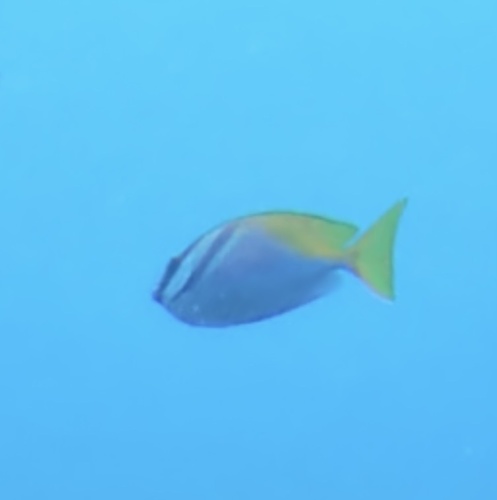
Doublebar Rabbitfish (Siganus virgatus)
Doublebar Rabbitfish Siganus virgatus A pale yellow rabbitfish with two dark brown vertical bars, one through the eye and one behind the pectoral fin, and numerous small blue spots on the head and body.to 30 cm · 1-25 m · by daycoral-rich areas of lagoons and seaward reefsOften seen in pairs grazing on algae; look for them near branching corals and outcrops. no rights reserved · CC0 · observation
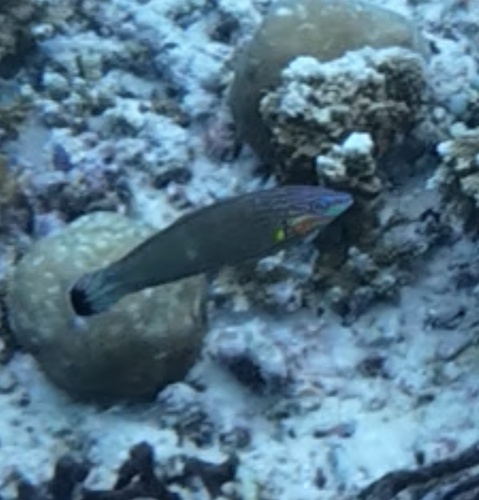
Pinstriped Wrasse (Halichoeres melanurus)
Pinstriped Wrasse Halichoeres melanurus A slender wrasse with a distinctive pattern of thin, dark horizontal stripes along its pale body, often seen flitting over the reef.to 13 cm · 1-25 m · by daymixed coral and rubble areas on reef flats and slopesWatch for quick, darting movements over patches of sand or rubble between coral heads. no rights reserved · CC0 · observation
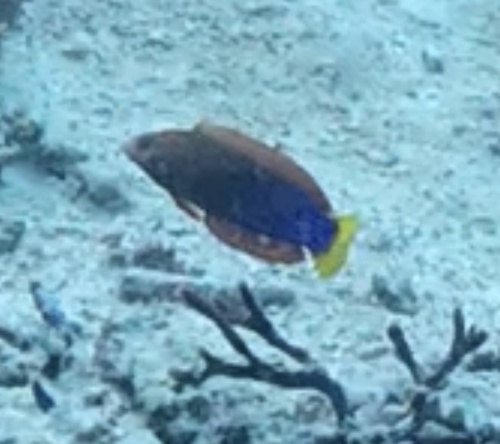
Yellowtail Coris (Coris gaimard)
Yellowtail Coris Coris gaimard A large, colourful wrasse with a striking red body and a bright yellow tail. Juveniles are orange with white spots and black-edged fins.to 40 cm · 1-30 m · by dayouter reef slopes and sandy areas near coral rubbleWatch for it foraging over sand and rubble, often turning over pieces with its snout. no rights reserved · CC0 · observation
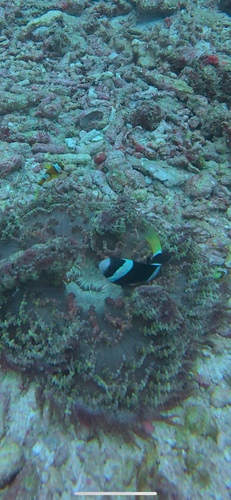
Clark's Anemonefish (Amphiprion clarkii)
Clark's Anemonefish Amphiprion clarkii A variable anemonefish, often dark brown to orange with three white bars; the tail fin may be yellow or white. It lives within the tentacles of host anemones.to 15 cm · 1-30 m · by dayhost anemones on reef slopes and lagoonsWatch for its protective behaviour; it will dart out and retreat to the anemone if approached too closely. no rights reserved · CC0 · observation