Home › Dive Schools › Indonesia › Lombok › dpm diving Gili

dpm diving Gili

SSI Dive Resort 📍 Lombok, Indonesia ★★★★★ 5.0 (2,659 reviews)

Photo: (c) River Ahlquist, some rights reserved (CC BY) · via iNaturalist

dpm diving Gili is an SSI Dive Resort in Lombok, Indonesia. The courses listed on its website include Scuba Diver, Open Water Diver and Deep Diver. It is based at Jl. Ikan Nautilus, Gili Trawangan, Kec. Pemenang, Kabupaten Lombok Utara, Nusa Tenggara Bar. 83352, Indonesia.

On Google it holds an average rating of 5.0 from 2659 reviews.

Sea temperatures in the surrounding waters range from 28°C in August to 30°C in November. Species recorded near these coordinates include Green Sea Turtle, Doublebar Rabbitfish, Oriental Sweetlips and Palette Tang.

🤿 Book a Diving Tour in Lombok, Indonesia

Tours powered by GetYourGuide. FindADive may earn a commission on bookings.

At a glance

  • One of 4 SSI centres listed in Lombok (4 dive centres there in total)
  • 6 dive sites within 60 km: Good Heart (0 km) · Trawangan Slope (1 km) · Shallow Turbo (1 km) · Gili Meno Wall (1 km) · Meno Slope (1 km) · Deep Turbo (1 km)
Certification SSI Dive Resort
Courses offered Scuba Diver, Open Water Diver, Deep Diver
Location Lombok, Indonesia
Address Jl. Ikan Nautilus, Gili Trawangan, Kec. Pemenang, Kabupaten Lombok Utara, Nusa Tenggara Bar. 83352, Indonesia
Google Rating ★★★★★ 5.0 2,659 reviews
GPS -8.3460°, 116.0414°
Operator ID 28e3c898-4e7c-44e1-b6b4-febb60dd02f5

Sea temperature through the year

Average sea surface temperature at the coordinates of dpm diving Gili, Lombok, Indonesia, by calendar month. The water is warmest in November at 30.3 °C and coldest in August at 28.2 °C, a spread of 2.1 kelvin over the year. Every month of the year averages 25 °C or more.

MonthJanFebMarAprMayJunJulAugSepOctNovDec
Sea temperature (°C)29.429.429.730.129.829.028.728.228.529.230.329.9

By season, the four quarterly averages at this location are spring (March to May) 29.9 °C, summer (June to August) 28.6 °C, autumn (September to November) 29.3 °C and winter (December to February) 29.6 °C.

Sea surface temperature from Open-Meteo Marine (CC BY 4.0), daily model means 2022-11 to 2024-12, sampled at the coordinates of this dive centre. Values are monthly averages of the daily means, not forecasts.

Marine life recorded in this area

Research-grade observations from iNaturalist near these coordinates.
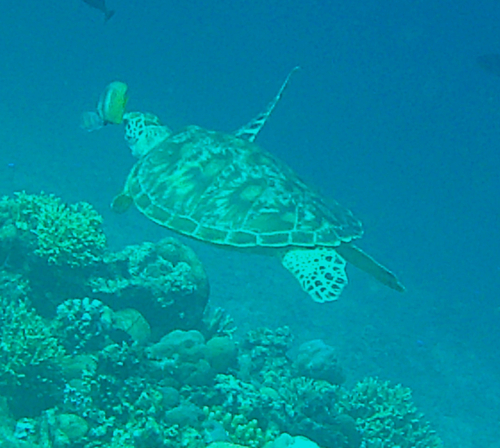
Green Sea Turtle (Chelonia mydas)
Green Sea Turtle Chelonia mydas A large sea turtle with a smooth, heart-shaped carapace, often seen swimming or resting on the seabed.to 1.5 m · surface to 40 m · day and nightseagrass beds, coral reefs, and sandy areasRemain still and avoid sudden movements; the turtle may approach if it feels unthreatened. (c) River Ahlquist, some rights reserved (CC BY) · observation
Doublebar Rabbitfish (Siganus virgatus)
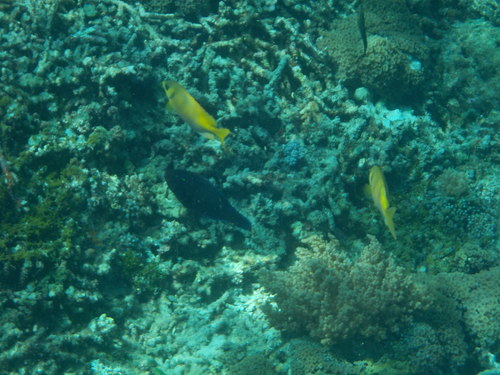
Doublebar Rabbitfish Siganus virgatus A pale yellow rabbitfish with two dark brown vertical bars, one through the eye and one behind the pectoral fin, and numerous small blue spots on the head and body.to 30 cm · 1-25 m · by daycoral-rich areas of lagoons and seaward reefsOften seen in pairs grazing on algae; look for them near branching corals and outcrops. (c) Jacek Pietruszewski, some rights reserved (CC BY) · observation
Oriental Sweetlips (Plectorhinchus vittatus)
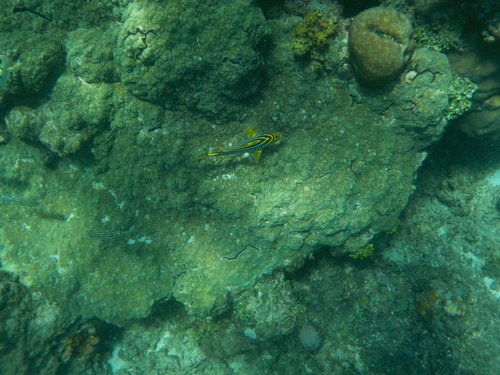
Oriental Sweetlips Plectorhinchus vittatus A juvenile fish with bold black and white stripes, often seen hovering near the reef. Adults become silvery-grey with faint spots.to 85 cm · 1-30 m · day and nightcoral and rocky reefs, often near overhangs or cavesJuveniles are more conspicuous; look for them hovering alone or in small groups near shelter. (c) Jacek Pietruszewski, some rights reserved (CC BY) · observation
Palette Tang (Paracanthurus hepatus)
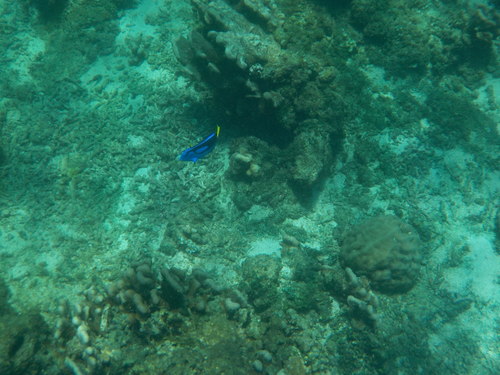
Palette Tang Paracanthurus hepatus A bright blue surgeonfish with a black 'palette' pattern on its back and a yellow tail, often seen grazing on algae.to 31 cm · 2-40 m · by dayouter reef slopes and drop-offsLook for it singly or in small groups swimming above the reef, often near Acropora coral thickets. (c) Jacek Pietruszewski, some rights reserved (CC BY) · observation