Home › Dive Sites › Thailand › Koh Tao › Mae Haad Bay

Mae Haad Bay

📍 Koh Tao, Thailand

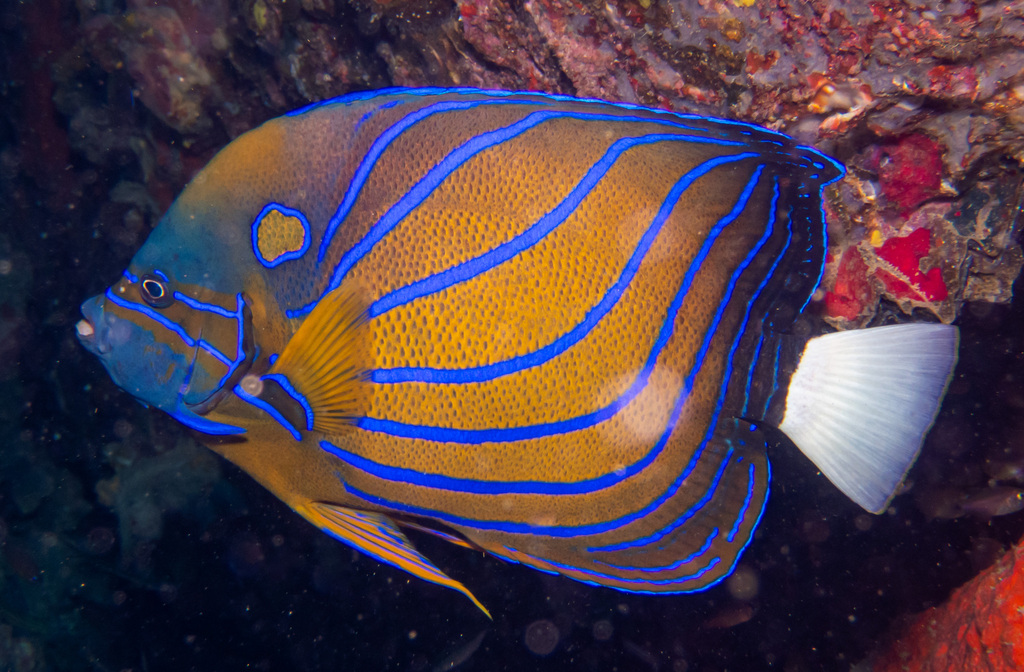
Bluering Angelfish (Pomacanthus annularis) — recorded at Mae Haad Bay

Mae Haad Bay is a dive site in Koh Tao, Thailand. Currents typically run at 0.6 km/h and reach 1.2 km/h on the strongest days. Water temperatures range from 28°C in January to 31°C in May. The typical daily tidal range is about 1.3 m. Species recorded in the area include Wire Coral Crab, Bluering Angelfish, False Flowerpot coral, Moon Wrasse and Surf Parrotfish.

Dive Conditions

💨
Current
0.6 km/h (1.2)
🌡️
Water Temp
28–31 °C

🤿 Book a Diving Tour in Mae Haad Bay

Tours powered by GetYourGuide. FindADive may earn a commission on bookings.

Typical Current 0.6 km/h (up to 1.2)
Water Temperature 28–31 °C
Tidal Range 1.3 m (typical daily)
GPS 10.0811°, 99.8165°

Data sources: currents and water temperature from Open-Meteo Marine (CC BY 4.0), hourly model values 2024. Tidal range is the median daily range of modelled sea level from Open-Meteo Marine, hourly values 2024. Species observations from iNaturalist, checked against the World Register of Marine Species.

Conditions at Mae Haad Bay through the year

Sea surface temperature at the site coordinates, averaged per month from hourly model values for 2024. The water is warmest in May at about 31 °C and coolest in January at about 28 °C, a spread of 3.3 degrees across the year.

Monthly sea surface temperature at Mae Haad Bay (°C)
JanFebMarAprMayJunJulAugSepOctNovDec
28.1 28.8 29.3 30.9 31.4 30.5 30.0 30.0 29.7 30.0 29.5 28.5

Ocean current at the site runs at a typical 0.6 km/h. In the strongest tenth of the hours modelled for 2024 it reaches 1.2 km/h, which is when entries are normally timed to slack water at the turn of the tide.

The tide moves the water level by a median 1.3 m over a day, and by up to 1.7 m on the largest days of the month. That range drives how much water is exchanged over the reef and when the current turns.

Offshore wave statistics are not shown for Mae Haad Bay: within 10 km of the site there is land in the directions from which 76 % of the larger waves in the area arrive, so open-sea values would overstate the swell at the site itself.

Satellite habitat mapping places Mae Haad Bay on a sheltered reef slope, over a seabed mapped as coral and algae.

How Mae Haad Bay compares

These comparisons use only the measured values above, set against the 376 dive sites published on findadive.com. A percentage shows the share of other sites with a lower (or higher) value, so it reads the same way wherever the site is.

Mae Haad Bay compared with all listed sites and with Koh Tao
MeasureThis siteCompared with all sitesMedian in Koh Tao
Mean water temperature29.7 °Cwarmer than 74 % of the other 375 sites29.7 °C (34 sites)
Water temperature in the coolest month28.1 °Ccooler than 54 % of the other 375 sites28.1 °C (34 sites)
Typical current0.6 km/hweaker than 88 % of the other 375 sites0.6 km/h (34 sites)
Current in the strongest 10 % of hours1.2 km/hweaker than 86 % of the other 375 sites1.2 km/h (34 sites)
Median daily tidal range1.3 msmaller than 69 % of the other 375 sites1.3 m (34 sites)

Water temperature, current and tide from Open-Meteo Marine (CC BY 4.0), hourly model values for 2024 at 10.0811°, 99.8165°. Wave statistics from ERA5-Ocean via Open-Meteo Marine (contains modified Copernicus Climate Change Service information 2015–2024), daily maximum wave height on a 0.5° grid; land shelter tested against Natural Earth coastlines. Reef structure and seabed cover from the Allen Coral Atlas © 2018–2023 Allen Coral Atlas Partnership and Arizona State University (CC BY 4.0).

Marine life recorded at this site

Research-grade observations from iNaturalist within about 12 km of these coordinates.
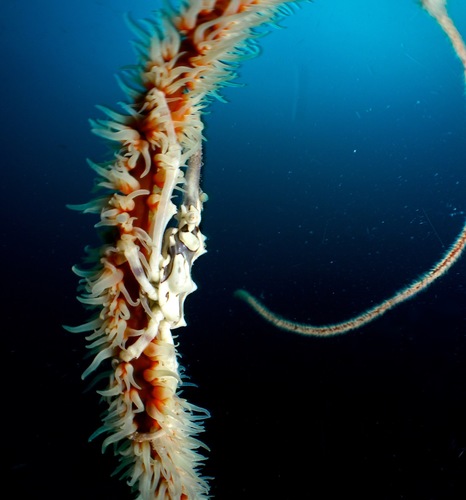
Wire Coral Crab (Xenocarcinus tuberculatus)
Wire Coral Crab Xenocarcinus tuberculatus A small, decorator crab that attaches bits of wire coral and other debris to its body for camouflage, making it look like a moving piece of coral.to 2 cm carapace · 10-40 m · day and nighton wire corals and gorgoniansLook for movement on wire coral branches; the crab's legs and body are often completely obscured by its camouflage. (c) klukoff, some rights reserved (CC BY) · observation
Bluering Angelfish (Pomacanthus annularis)
Bluering Angelfish Pomacanthus annularis A large angelfish with a blue-ringed black spot on its side, yellow tail and blue-edged fins. Adults have a blue ring around the spot, juveniles are dark with blue and white curved bars.to 45 cm · 3-30 m · by daycoral-rich areas of reefs and slopesOften seen singly or in pairs, swimming near ledges and overhangs. Listen for a distinct clicking sound it makes while feeding. (c) portioid, some rights reserved (CC BY) · observation
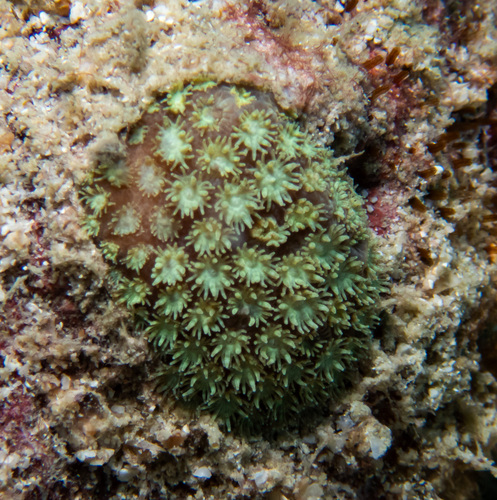
False Flowerpot coral (Bernardpora stutchburyi)
False Flowerpot coral Bernardpora stutchburyi A colonial stony coral forming small, compact clumps of short, thick branches with rounded tips, resembling a flowerpot.colonies to 30 cm · 3-30 m · day and nightshallow reef slopes and lagoonsLook for its distinctive, stubby branches among other branching corals; polyps are often extended during the day. (c) portioid, some rights reserved (CC BY) · observation
Moon Wrasse (Thalassoma lunare)
Moon Wrasse Thalassoma lunare A colourful wrasse with a bright yellow crescent on the tail base, often seen swimming actively above the reef.to 45 cm · 1-20 m · by daycoral-rich areas of lagoons and seaward reefsWatch for its constant movement; it often darts into the water column to feed on plankton. (c) Ian Dugdale, some rights reserved (CC BY) · observation
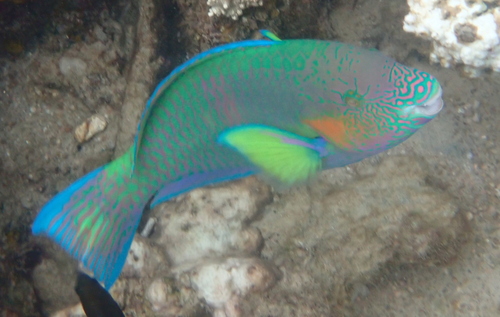
Surf Parrotfish (Scarus rivulatus)
Surf Parrotfish Scarus rivulatus A medium-sized parrotfish with a blue-green body, orange markings on the head, and a pale tail. It scrapes algae from hard surfaces with its beak-like teeth.to 40 cm · 1-30 m · by dayouter reef slopes and lagoonsListen for the sound of scraping as it feeds on the reef; it often moves in small groups. (c) Jan Ebr & Ivana Ebrová, some rights reserved (CC BY) · observation
Decorated Sandgoby (Istigobius decoratus)
Decorated Sandgoby Istigobius decoratus A small, pale sandgoby with a pattern of fine brown spots and lines on its head and body, often seen resting on the bottom.to 9 cm · 1-25 m · by daysandy or silty substrates near reefsLook for a small, stationary fish on the sand; it may dart into a burrow if approached too quickly. (c) portioid, some rights reserved (CC BY) · observation
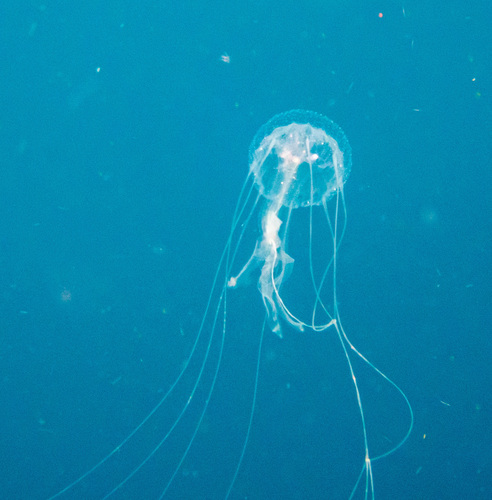
Amakusa Jelly (Sanderia malayensis)
Amakusa Jelly Sanderia malayensis A small, translucent jellyfish with a shallow bell and numerous long, fine tentacles trailing beneath.bell to 5 cm · day and nightopen water, often near the surfaceObserve from a distance; its tentacles can deliver a mild sting. (c) portioid, some rights reserved (CC BY) · observation
Redspot Emperor (Lethrinus lentjan)
Redspot Emperor Lethrinus lentjan A large, silvery-grey emperor fish with a distinctive red patch on the operculum and often red fins. It is often seen solitary or in small groups.to 50 cm · 5-50 m · day and nightsandy areas near coral reefs and seagrass bedsLook for it hovering just above the sand, often near the edge of a reef where it forages. (c) portioid, some rights reserved (CC BY) · observation