Home › Dive Sites › Indonesia › Bali › Bunutan

Bunutan

📍 Bali, Indonesia

Jester Trapania Nudibranch (Trapania scurra) — recorded at Bunutan

Bunutan is a dive site in Bali, Indonesia. The sea floor at the site position lies at about 9 meters. Currents typically run at 2 km/h and reach 3.8 km/h on the strongest days. Water temperatures range from 28°C in August to 30°C in December. The typical daily tidal range is about 1.3 m. Species recorded in the area include Psilaxis radiatus, Jester Trapania Nudibranch, Dragon Seamoth, Yellowfin Goatfish and Trapania reticulata.

Dive Conditions

⬇️
Seabed Depth
9m
💨
Current
2.0 km/h (3.8)
🌡️
Water Temp
28–30 °C

🤿 Book a Diving Tour in Bunutan

Tours powered by GetYourGuide. FindADive may earn a commission on bookings.

Typical Current 2.0 km/h (up to 3.8)
Seabed Depth 9 m
Water Temperature 28–30 °C
Tidal Range 1.3 m (typical daily)
GPS -8.3447°, 115.6865°

Data sources: currents and water temperature from Open-Meteo Marine (CC BY 4.0), hourly model values 2024; seabed depth from the GEBCO 2020 Grid, sampled at the site coordinates (grid resolution about 450 m). Tidal range is the median daily range of modelled sea level from Open-Meteo Marine, hourly values 2024. Species observations from iNaturalist, checked against the World Register of Marine Species.

Conditions at Bunutan through the year

Sea surface temperature at the site coordinates, averaged per month from hourly model values for 2024. The water is warmest in December at about 30 °C and coolest in August at about 28 °C, a spread of 2.5 degrees across the year.

Monthly sea surface temperature at Bunutan (°C)
JanFebMarAprMayJunJulAugSepOctNovDec
29.7 29.4 29.5 30.1 29.5 29.0 28.5 27.9 28.3 29.2 30.3 30.4

Ocean current at the site runs at a typical 2.0 km/h. In the strongest tenth of the hours modelled for 2024 it reaches 3.8 km/h, which is when entries are normally timed to slack water at the turn of the tide.

The tide moves the water level by a median 1.3 m over a day, and by up to 1.8 m on the largest days of the month. That range drives how much water is exchanged over the reef and when the current turns.

Offshore wave statistics are not shown for Bunutan: within 10 km of the site there is land in the directions from which 100 % of the larger waves in the area arrive, so open-sea values would overstate the swell at the site itself.

The seabed directly under the site coordinates sits at about 9 m. This is a bathymetry grid value with a cell size of roughly 450 m, so it describes the depth of the area rather than the deepest point a dive can reach.

How Bunutan compares

These comparisons use only the measured values above, set against the 376 dive sites published on findadive.com. A percentage shows the share of other sites with a lower (or higher) value, so it reads the same way wherever the site is.

Bunutan compared with all listed sites and with Bali
MeasureThis siteCompared with all sitesMedian in Bali
Mean water temperature29.3 °Ccooler than 63 % of the other 375 sites29.1 °C (99 sites)
Water temperature in the coolest month27.9 °Ccooler than 74 % of the other 375 sites27.8 °C (99 sites)
Typical current2.0 km/hstronger than 64 % of the other 375 sites3.2 km/h (99 sites)
Current in the strongest 10 % of hours3.8 km/hstronger than 66 % of the other 375 sites5.7 km/h (99 sites)
Median daily tidal range1.3 msmaller than 69 % of the other 375 sites1.5 m (99 sites)

Water temperature, current and tide from Open-Meteo Marine (CC BY 4.0), hourly model values for 2024 at -8.3447°, 115.6865°. Seabed depth from the GEBCO 2020 Grid. Wave statistics from ERA5-Ocean via Open-Meteo Marine (contains modified Copernicus Climate Change Service information 2015–2024), daily maximum wave height on a 0.5° grid; land shelter tested against Natural Earth coastlines.

Marine life recorded at this site

Research-grade observations from iNaturalist within about 12 km of these coordinates.

Psilaxis radiatus (Psilaxis radiatus)
Psilaxis radiatus Psilaxis radiatus A small, conical sea snail with a sharply pointed, turreted shell, often covered in fine radial ridges.to 2.5 cmsandy or muddy substratesLook for its pointed shell projecting from the sediment; it may be partially buried. (c) Bernard Picton, some rights reserved (CC BY) · observation
Jester Trapania Nudibranch (Trapania scurra)
Jester Trapania Nudibranch Trapania scurra A small nudibranch with a white body covered in orange and yellow spots, and two long, curled oral tentacles that resemble a jester's hat.to 2 cm · 5-25 m · day and nightsponges on rocky reefs and wallsLook closely on encrusting sponges; its colour pattern provides excellent camouflage against the sponge's surface. (c) Bernard Picton, some rights reserved (CC BY) · observation
Dragon Seamoth (Eurypegasus draconis)
Dragon Seamoth Eurypegasus draconis A small, flattened fish with a boxy body and large, wing-like pectoral fins. It walks on the seabed using modified pelvic fins.to 10 cm · 3-90 m · day and nightsandy or silty bottoms, often near rubble or seagrassLook for a small, triangular shape on the sand; it may stay still, relying on camouflage, or walk away slowly. (c) portioid, some rights reserved (CC BY) · observation
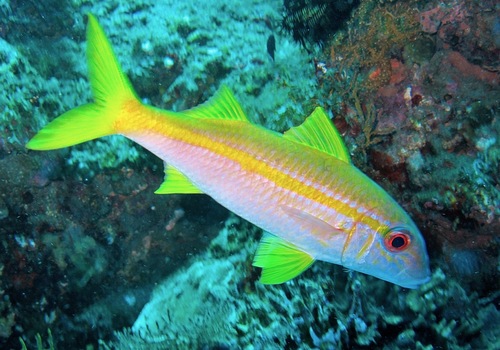
Yellowfin Goatfish (Mulloidichthys vanicolensis)
Yellowfin Goatfish Mulloidichthys vanicolensis A silvery-white goatfish with a yellow stripe along its body and bright yellow fins, often seen foraging in small groups.to 40 cm · 1-40 m · by daysandy areas adjacent to coral reefsLook for the probing barbels under its chin as it searches the sand for prey. (c) Bernard DUPONT, some rights reserved (CC BY) · observation
Trapania reticulata (Trapania reticulata)
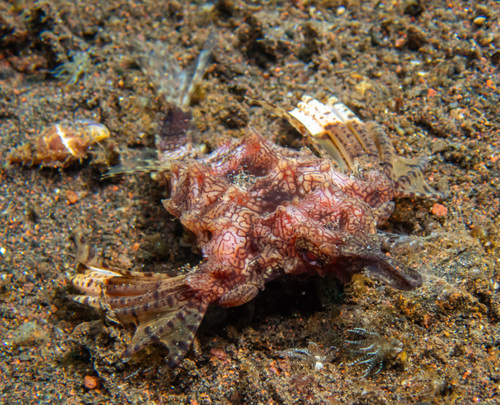
Trapania reticulata Trapania reticulata A small nudibranch with a translucent white body covered in a network of brown lines, and two pairs of long, finger-like appendages on its head and tail.to 2 cm · 5-20 m · day and nightsponges on shaded reef walls and overhangsLook for its distinctive shape and colour pattern on encrusting sponges, often in areas with some water movement. (c) Bernard Picton, some rights reserved (CC BY) · observation
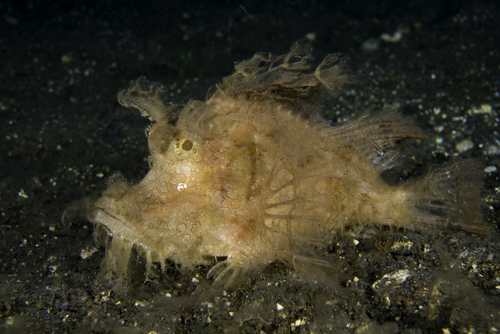
Weedy Scorpionfish (Rhinopias frondosa)
Weedy Scorpionfish Rhinopias frondosa A scorpionfish with a highly variable appearance, often mottled in red, pink, purple, or yellow, covered in fleshy skin flaps and tassels for camouflage.to 23 cm · 10-90 m · day and nightreef slopes and rubble, often perched on sponges or coralLook for its distinctive, frog-like profile and watch for slight movements; it often sits perfectly still. (c) Bernard Picton, some rights reserved (CC BY) · observation
Pygmy Seahorse (Hippocampus bargibanti)
Pygmy Seahorse Hippocampus bargibanti A tiny seahorse with a pink or yellow body covered in tubercles, perfectly camouflaged on its host gorgonian.to 2.4 cm · 16-40 m · day and nightgorgonian sea fans, especially Muricella speciesScan gorgonian fans slowly and closely; look for a small, rounded shape that matches the polyps. (c) Rachel Crane, some rights reserved (CC BY) · observation
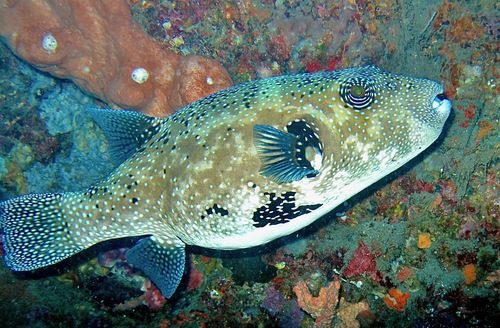
Bluespotted Puffer (Arothron caeruleopunctatus)
Bluespotted Puffer Arothron caeruleopunctatus A pufferfish with a greyish-brown body densely covered in small blue spots. It has a blunt head and can inflate its body when threatened.to 80 cm · 1-30 m · by dayreef flats, slopes and lagoons, often near rubble or sandLook for it cruising slowly over the reef; it is often solitary and may allow a slow approach. (c) Bernard DUPONT, some rights reserved (CC BY) · observation