Home › Dive Schools › Thailand › Koh Tao › Pura Vida Koh Tao

Pura Vida Koh Tao

SSI Dive Resort 📍 Koh Tao, Thailand ★★★★★ 5.0 (3,762 reviews)

Photo: Nott Peera · CC BY · via iNaturalist

Pura Vida Koh Tao is a dive centre on Koh Tao, Thailand. It offers Try Scuba Diving and Open Water Diver courses, as well as fun dives for certified divers. The centre states it is number one on Tripadvisor for diving activities in Koh Tao and received the Travelers’ Choice award in 2022. Services are available in Spanish.

Courses offered

Course Price
Try Scuba Diving –
Open Water Diver –

Diving with Pura Vida Koh Tao

The centre has its own boat for diving trips, according to the centre.

On Google it holds an average rating of 5.0 from 3762 reviews.

Sea temperatures in the surrounding waters range from 28°C in January to 31°C in May.

🤿 Book a Diving Tour in Koh Tao, Thailand

Tours powered by GetYourGuide. FindADive may earn a commission on bookings.

At a glance

  • One of 23 SSI centres listed in Koh Tao (44 dive centres there in total)
  • 6 dive sites within 60 km: Mae Haad Bay (1 km) · Sairee Reef (1 km) · Hin Ngam Bay (3 km) · Tanote Bay (3 km) · Htms Sattakut (3 km) · Shark Bay (3 km)
Certification SSI Dive Resort
Location Koh Tao, Thailand
Address 9/24, ตำบล เกาะเต่า Koh Tao, สุราษฎร์ธานี 84360, Thailand
Phone 077 457 041
Google Rating ★★★★★ 5.0 3,762 reviews
GPS 10.0847°, 99.8254°
Operator ID 94c3a9f8-c93a-4d2a-9ffb-985da3478709

Sea temperature through the year

Average sea surface temperature at the coordinates of Pura Vida Koh Tao, Koh Tao, Thailand, by calendar month. The water is warmest in May at 31.4 °C and coldest in January at 28.1 °C, a spread of 3.3 kelvin over the year. Every month of the year averages 25 °C or more.

MonthJanFebMarAprMayJunJulAugSepOctNovDec
Sea temperature (°C)28.128.729.230.831.430.430.130.029.729.929.528.5

By season, the four quarterly averages at this location are spring (March to May) 30.5 °C, summer (June to August) 30.2 °C, autumn (September to November) 29.7 °C and winter (December to February) 28.4 °C.

Sea surface temperature from Open-Meteo Marine (CC BY 4.0), daily model means 2022-11 to 2024-12, sampled at the coordinates of this dive centre. Values are monthly averages of the daily means, not forecasts.

Marine life recorded in this area

Research-grade observations from iNaturalist near these coordinates.
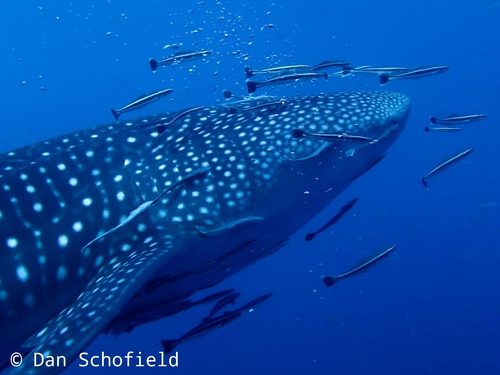
Whale Shark (Rhincodon typus)
Whale Shark Rhincodon typus A very large, slow-moving shark with a broad, flattened head, a wide mouth, and a distinctive pattern of pale spots and stripes on a dark grey back.to 18 m · surface to 100 m · day and nightopen water, often near the surfaceObserve from a respectful distance; its path is predictable as it swims with its mouth open to filter feed. (c) Dan Schofield, some rights reserved (CC BY) · observation
Wire Coral Crab (Xenocarcinus tuberculatus)
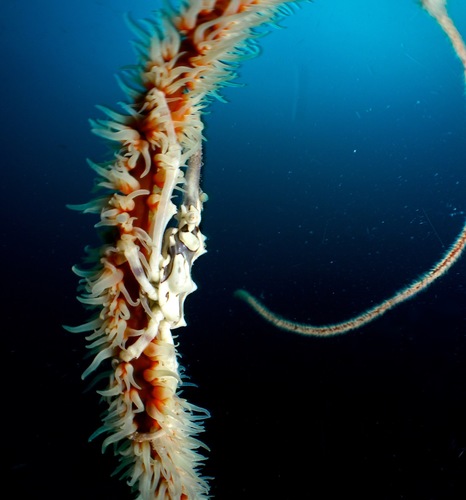
Wire Coral Crab Xenocarcinus tuberculatus A small, decorator crab that attaches bits of wire coral and other debris to its body for camouflage, making it look like a moving piece of coral.to 2 cm carapace · 10-40 m · day and nighton wire corals and gorgoniansLook for movement on wire coral branches; the crab's legs and body are often completely obscured by its camouflage. (c) klukoff, some rights reserved (CC BY) · observation
Bluering Angelfish (Pomacanthus annularis)
Bluering Angelfish Pomacanthus annularis A large angelfish with a blue-ringed black spot on its side, yellow tail and blue-edged fins. Adults have a blue ring around the spot, juveniles are dark with blue and white curved bars.to 45 cm · 3-30 m · by daycoral-rich areas of reefs and slopesOften seen singly or in pairs, swimming near ledges and overhangs. Listen for a distinct clicking sound it makes while feeding. (c) portioid, some rights reserved (CC BY) · observation
False Flowerpot coral (Bernardpora stutchburyi)
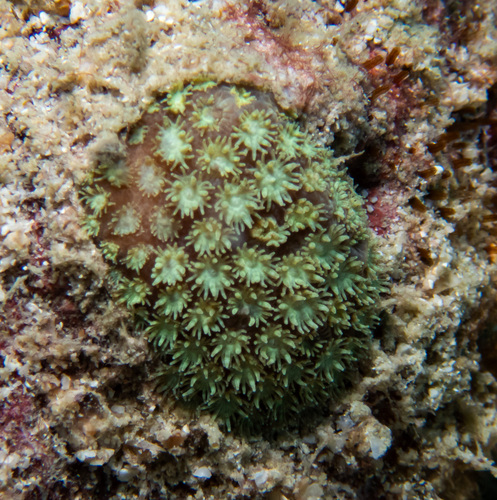
False Flowerpot coral Bernardpora stutchburyi A colonial stony coral forming small, compact clumps of short, thick branches with rounded tips, resembling a flowerpot.colonies to 30 cm · 3-30 m · day and nightshallow reef slopes and lagoonsLook for its distinctive, stubby branches among other branching corals; polyps are often extended during the day. (c) portioid, some rights reserved (CC BY) · observation