Home › Dive Sites › Indonesia › Bali › Deep Blue

Deep Blue

📍 Bali, Indonesia

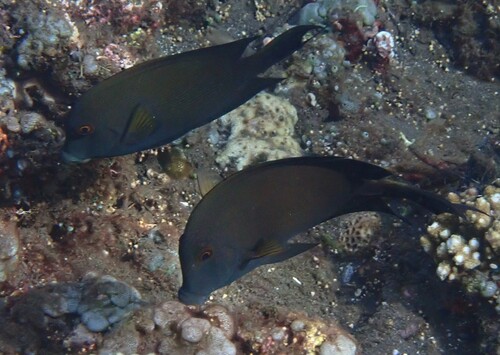
Lined Bristletooth (Ctenochaetus striatus) — recorded at Deep Blue

Deep Blue is a dive site in Bali, Indonesia. Currents typically run at 4.1 km/h and reach 6 km/h on the strongest days. Water temperatures range from 28°C in August to 30°C in December. The typical daily tidal range is about 1.3 m. Species recorded in the area include Dragon Seamoth, Lined Bristletooth, Moorish Idol, Indian Vagabond Butterflyfish and Eyeline Surgeonfish.

Dive Conditions

💨
Current
4.1 km/h (6.0)
🌡️
Water Temp
28–30 °C

🤿 Book a Diving Tour in Deep Blue

Tours powered by GetYourGuide. FindADive may earn a commission on bookings.

Typical Current 4.1 km/h (up to 6.0)
Water Temperature 28–30 °C
Tidal Range 1.3 m (typical daily)
GPS -8.3563°, 115.6951°

Data sources: currents and water temperature from Open-Meteo Marine (CC BY 4.0), hourly model values 2024. Tidal range is the median daily range of modelled sea level from Open-Meteo Marine, hourly values 2024. Species observations from iNaturalist, checked against the World Register of Marine Species.

Conditions at Deep Blue through the year

Sea surface temperature at the site coordinates, averaged per month from hourly model values for 2024. The water is warmest in December at about 30 °C and coolest in August at about 28 °C, a spread of 1.9 degrees across the year.

Monthly sea surface temperature at Deep Blue (°C)
JanFebMarAprMayJunJulAugSepOctNovDec
29.2 29.3 29.1 29.1 29.1 28.8 28.4 27.8 28.0 28.6 29.5 29.7

Ocean current at the site runs at a typical 4.1 km/h. In the strongest tenth of the hours modelled for 2024 it reaches 6.0 km/h, which is when entries are normally timed to slack water at the turn of the tide.

The tide moves the water level by a median 1.3 m over a day, and by up to 1.8 m on the largest days of the month. That range drives how much water is exchanged over the reef and when the current turns.

Offshore wave statistics are not shown for Deep Blue: within 10 km of the site there is land in the directions from which 100 % of the larger waves in the area arrive, so open-sea values would overstate the swell at the site itself.

Satellite habitat mapping places Deep Blue on an outer reef slope, over a seabed mapped as coral and algae. The classification comes from the nearest mapped reef polygon, about 40 m from the listed coordinates, so it describes the reef the site sits on rather than a single point on it.

How Deep Blue compares

These comparisons use only the measured values above, set against the 376 dive sites published on findadive.com. A percentage shows the share of other sites with a lower (or higher) value, so it reads the same way wherever the site is. Deep Blue sits with its typical current in the top tenth of all listed sites.

Deep Blue compared with all listed sites and with Bali
MeasureThis siteCompared with all sitesMedian in Bali
Mean water temperature28.9 °Ccooler than 79 % of the other 375 sites29.1 °C (99 sites)
Water temperature in the coolest month27.8 °Ccooler than 80 % of the other 375 sites27.8 °C (99 sites)
Typical current4.1 km/hstronger than 97 % of the other 375 sites3.2 km/h (99 sites)
Current in the strongest 10 % of hours6.0 km/hstronger than 88 % of the other 375 sites5.7 km/h (99 sites)
Median daily tidal range1.3 msmaller than 69 % of the other 375 sites1.5 m (99 sites)

Water temperature, current and tide from Open-Meteo Marine (CC BY 4.0), hourly model values for 2024 at -8.3563°, 115.6951°. Wave statistics from ERA5-Ocean via Open-Meteo Marine (contains modified Copernicus Climate Change Service information 2015–2024), daily maximum wave height on a 0.5° grid; land shelter tested against Natural Earth coastlines. Reef structure and seabed cover from the Allen Coral Atlas © 2018–2023 Allen Coral Atlas Partnership and Arizona State University (CC BY 4.0).

Marine life recorded at this site

Research-grade observations from iNaturalist within about 12 km of these coordinates.
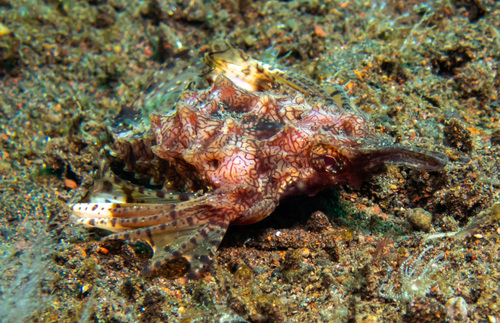
Dragon Seamoth (Eurypegasus draconis)
Dragon Seamoth Eurypegasus draconis A small, flattened fish with a boxy body and large, wing-like pectoral fins. It walks on the seabed using modified pelvic fins.to 10 cm · 3-90 m · day and nightsandy or silty bottoms, often near rubble or seagrassLook for a small, triangular shape on the sand; it may stay still, relying on camouflage, or walk away slowly. (c) portioid, some rights reserved (CC BY) · observation
Lined Bristletooth (Ctenochaetus striatus)
Lined Bristletooth Ctenochaetus striatus A brown surgeonfish with numerous fine blue lines along its body and a yellow tail, grazing algae with comb-like teeth.to 26 cm · 1-30 m · by daycoral-rich areas of reef flats, lagoons and seaward reefsLook for it singly or in small groups, often moving slowly over coral or rubble while picking at the surface. (c) Jan Ebr & Ivana Ebrová, some rights reserved (CC BY) · observation
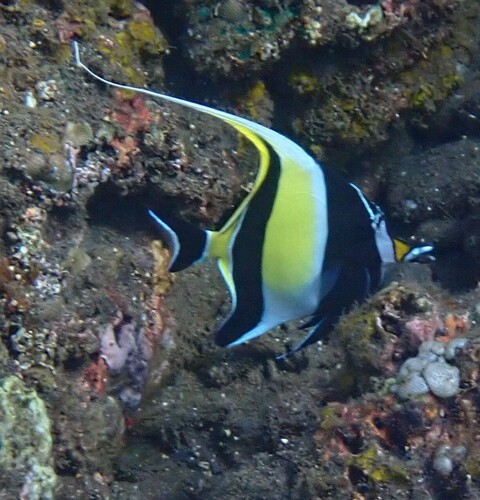
Moorish Idol (Zanclus cornutus)
Moorish Idol Zanclus cornutus A strikingly patterned reef fish with a deep, laterally compressed body, a long white dorsal filament, and bold black, white and yellow bands.to 23 cm · 3-180 m · by daycoral reefs and rocky areasOften seen in pairs or small groups swimming in the water column above the reef, browsing on sponges and tunicates. (c) Jan Ebr & Ivana Ebrová, some rights reserved (CC BY) · observation
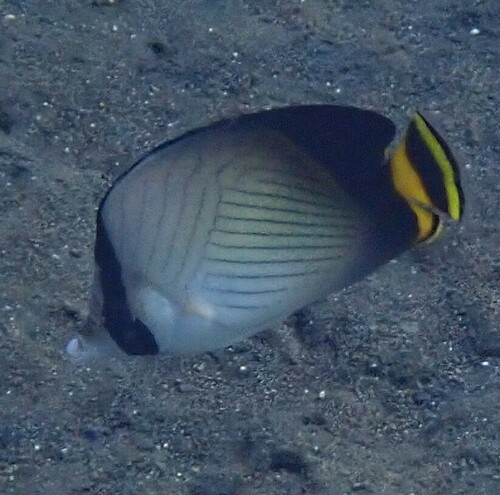
Indian Vagabond Butterflyfish (Chaetodon decussatus)
Indian Vagabond Butterflyfish Chaetodon decussatus A butterflyfish with a silvery-white body crossed by diagonal black lines, forming a chequered pattern. It has a black band through the eye and a yellow-edged tail.to 20 cm · 1-30 m · by daycoral-rich areas of reefs and lagoonsOften seen in pairs; look for them inspecting coral heads and crevices for food. (c) Jan Ebr & Ivana Ebrová, some rights reserved (CC BY) · observation
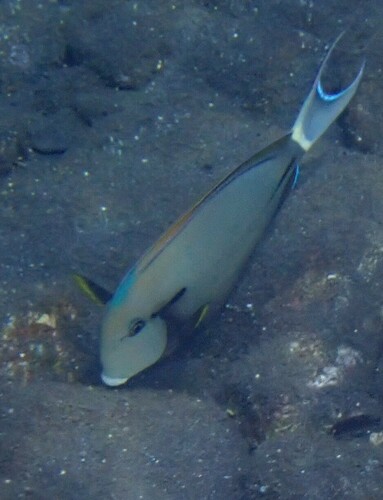
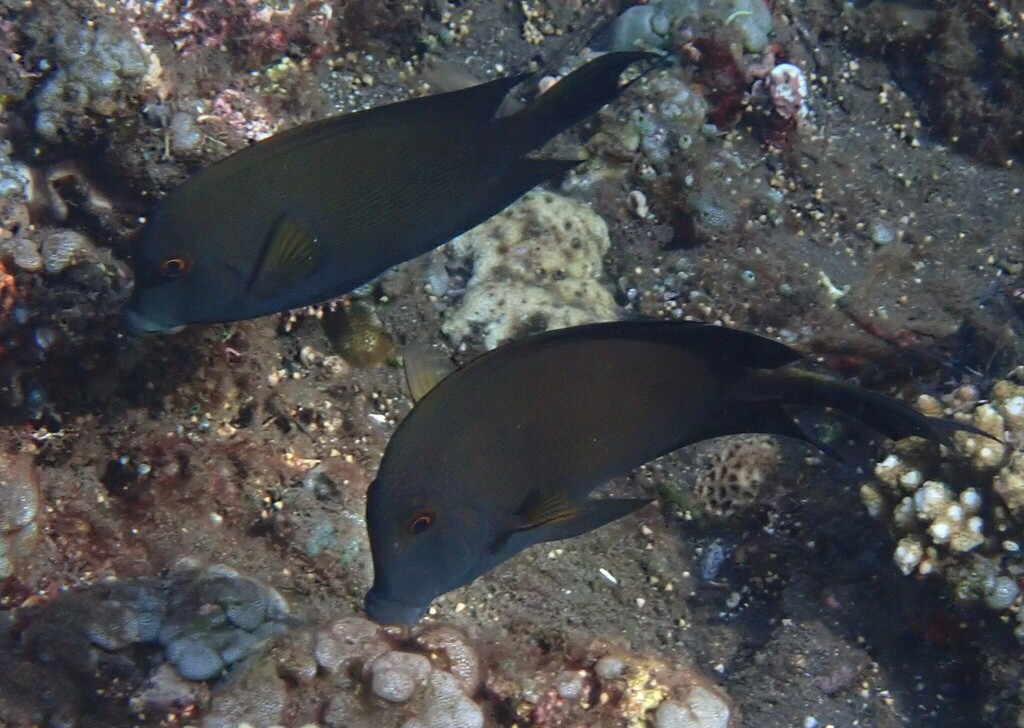
Eyeline Surgeonfish (Acanthurus nigricauda)
Eyeline Surgeonfish Acanthurus nigricauda A surgeonfish with a dark brown to black body, a distinctive white band behind the eye, and a yellow-edged tail base.to 40 cm · 1-30 m · by dayouter reef slopes and channelsOften seen grazing in small groups; look for the bright white eye band against the dark body. (c) Jan Ebr & Ivana Ebrová, some rights reserved (CC BY) · observation
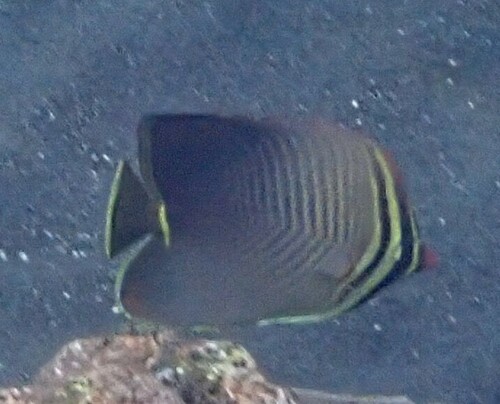
Eastern Triangle Butterflyfish (Chaetodon baronessa)
Eastern Triangle Butterflyfish Chaetodon baronessa A butterflyfish with a pattern of dark diagonal lines on a pale body, forming a series of triangles. It has a black eye bar and often swims in pairs.to 16 cm · 1-30 m · by daycoral-rich areas of lagoons and outer reefsLook for pairs actively feeding on coral polyps, especially Acropora species, which are their primary food. (c) Jan Ebr & Ivana Ebrová, some rights reserved (CC BY) · observation
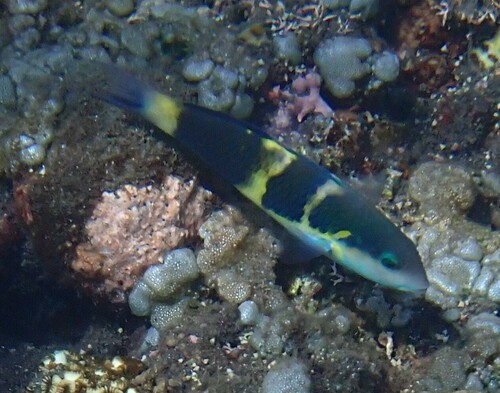
Jansen's Wrasse (Thalassoma jansenii)
Jansen's Wrasse Thalassoma jansenii A slender wrasse with a greenish-blue body, a yellow tail, and a distinctive black spot on the dorsal fin base.to 20 cm · 3-40 m · by dayouter reef slopes and channels with rich coral growthOften seen swimming in small groups above the reef; look for the black spot on its back. (c) Jan Ebr & Ivana Ebrová, some rights reserved (CC BY) · observation
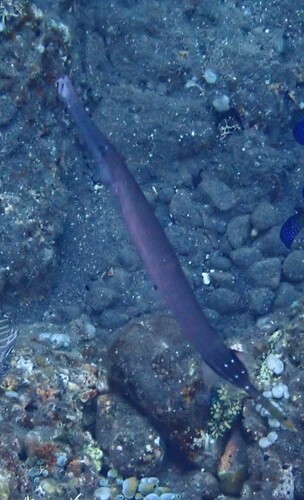
Pacific Trumpetfish (Aulostomus chinensis)
Pacific Trumpetfish Aulostomus chinensis A slender, elongated fish that often hovers vertically among branching corals or swims slowly, sometimes shadowing larger fish.to 80 cm · 1-30 m · by daycoral reefs and seagrass bedsLook for its motionless vertical posture near coral heads, or watch for it swimming close behind large parrotfish or groupers. (c) Jan Ebr & Ivana Ebrová, some rights reserved (CC BY) · observation