Home › Dive Sites › Thailand › Turtle Rock

Turtle Rock

📍 Thailand

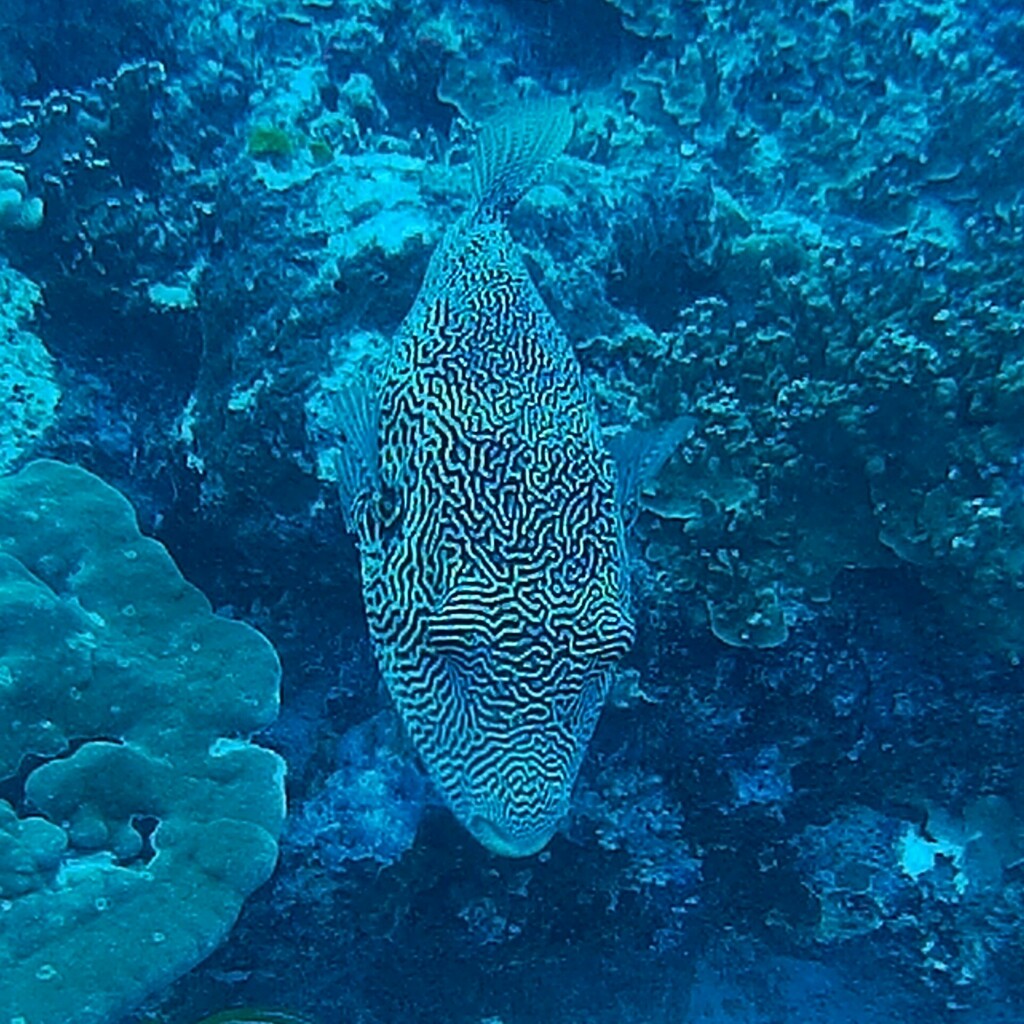
Map Puffer (Arothron mappa) — recorded at Turtle Rock

Turtle Rock is a dive site in Thailand. It lies within the Mu Ko Similan National Park. Currents typically run at 0.9 km/h and reach 1.5 km/h on the strongest days. Water temperatures range from 29°C in January to 31°C in May. The typical daily tidal range is about 1.6 m. Species recorded in the area include Map Puffer, Lined Bristletooth, Indo-Pacific Sergeant Major, Checkered Snapper and Indian Dascyllus.

Dive Conditions

💨
Current
0.9 km/h (1.5)
🌡️
Water Temp
29–31 °C

🤿 Book a Diving Tour in Turtle Rock

Tours powered by GetYourGuide. FindADive may earn a commission on bookings.

Typical Current 0.9 km/h (up to 1.5)
Water Temperature 29–31 °C
Tidal Range 1.6 m (typical daily)
GPS 8.6491°, 97.6379°

Data sources: currents and water temperature from Open-Meteo Marine (CC BY 4.0), hourly model values 2024. Tidal range is the median daily range of modelled sea level from Open-Meteo Marine, hourly values 2024. Protected area boundary from OpenStreetMap contributors (ODbL). Species observations from iNaturalist, checked against the World Register of Marine Species.

Conditions at Turtle Rock through the year

Sea surface temperature at the site coordinates, averaged per month from hourly model values for 2024. The water is warmest in May at about 31 °C and coolest in January at about 29 °C, a spread of 2.2 degrees across the year.

Monthly sea surface temperature at Turtle Rock (°C)
JanFebMarAprMayJunJulAugSepOctNovDec
28.9 29.1 29.8 30.7 31.1 29.9 29.4 29.4 28.9 29.4 29.6 29.0

Ocean current at the site runs at a typical 0.9 km/h. In the strongest tenth of the hours modelled for 2024 it reaches 1.5 km/h, which is when entries are normally timed to slack water at the turn of the tide.

The tide moves the water level by a median 1.6 m over a day, and by up to 2.2 m on the largest days of the month. That range drives how much water is exchanged over the reef and when the current turns.

In the open sea off Turtle Rock, the highest wave of the day exceeded 1.5 m on 15.0 % of days between 2015 and 2024. The roughest month was August (46 % of days), the calmest March (0 %).

Share of days with waves above 1.5 m, open sea near Turtle Rock (%, 2015–2024)
JanFebMarAprMayJunJulAugSepOctNovDec
110116294346291201

Turtle Rock lies inside Mu Ko Similan National Park. Protected areas can carry their own rules on entry fees, permits, anchoring and fishing; check the current rules with a local operator before you dive.

How Turtle Rock compares

These comparisons use only the measured values above, set against the 376 dive sites published on findadive.com. A percentage shows the share of other sites with a lower (or higher) value, so it reads the same way wherever the site is.

Turtle Rock compared with all listed sites and with Thailand
MeasureThis siteCompared with all sitesMedian in Thailand
Mean water temperature29.6 °Cwarmer than 64 % of the other 375 sites29.7 °C (126 sites)
Water temperature in the coolest month28.9 °Cwarmer than 87 % of the other 375 sites28.7 °C (126 sites)
Typical current0.9 km/hweaker than 62 % of the other 375 sites0.7 km/h (126 sites)
Current in the strongest 10 % of hours1.5 km/hweaker than 71 % of the other 375 sites1.3 km/h (126 sites)
Median daily tidal range1.6 mlarger than 70 % of the other 375 sites1.6 m (126 sites)

Water temperature, current and tide from Open-Meteo Marine (CC BY 4.0), hourly model values for 2024 at 8.6491°, 97.6379°. Protected area boundary from OpenStreetMap contributors (ODbL). Wave statistics from ERA5-Ocean via Open-Meteo Marine (contains modified Copernicus Climate Change Service information 2015–2024), daily maximum wave height on a 0.5° grid; land shelter tested against Natural Earth coastlines.

Marine life recorded at this site

Research-grade observations from iNaturalist within about 12 km of these coordinates.
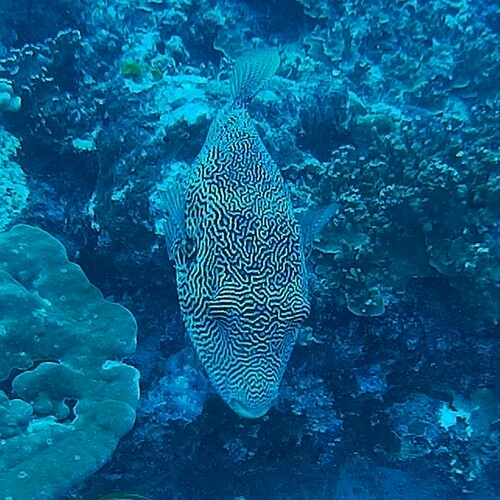
Map Puffer (Arothron mappa)
Map Puffer Arothron mappa A large, robust pufferfish with a pattern of dark lines and spots on a pale background, resembling a map. It has a blunt face and small spines.to 65 cm · 3-30 m · day and nightouter reef slopes and lagoons, often near coral or rubbleOften seen hovering motionless. It may inflate if threatened, but this is stressful for the fish; observe from a distance. (c) nbasargin, some rights reserved (CC BY) · observation
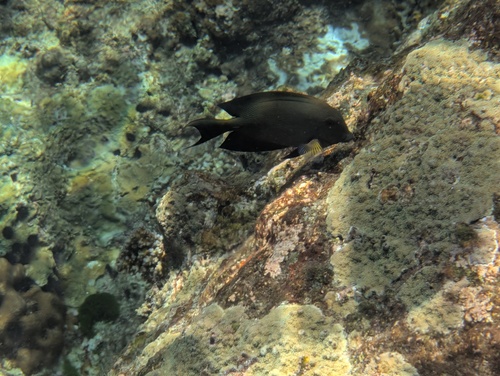
Lined Bristletooth (Ctenochaetus striatus)
Lined Bristletooth Ctenochaetus striatus A brown surgeonfish with numerous fine blue lines along its body and a yellow tail, grazing algae with comb-like teeth.to 26 cm · 1-30 m · by daycoral-rich areas of reef flats, lagoons and seaward reefsLook for it singly or in small groups, often moving slowly over coral or rubble while picking at the surface. (c) Zac Peterson, some rights reserved (CC BY) · observation
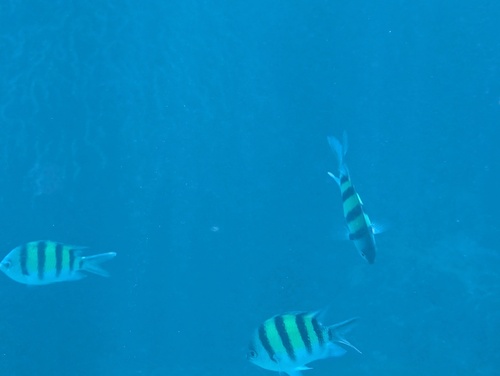
Indo-Pacific Sergeant Major (Abudefduf vaigiensis)
Indo-Pacific Sergeant Major Abudefduf vaigiensis A pale-bodied damselfish with five dark vertical bars, often seen in large, active schools above the reef.to 20 cm · 1-12 m · by dayshallow reef flats, slopes, and piersLook for shimmering schools near the surface, especially around structures like buoys or jetty pilings. (c) Zac Peterson, some rights reserved (CC BY) · observation
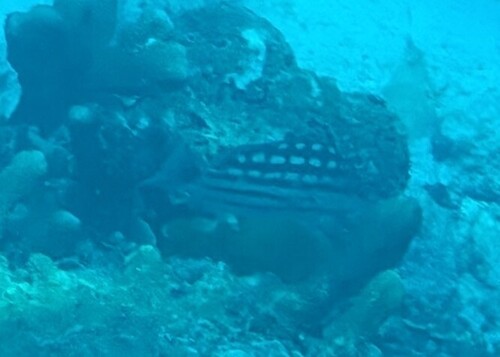
Checkered Snapper (Lutjanus decussatus)
Checkered Snapper Lutjanus decussatus A small snapper with a distinctive pattern of dark vertical bars on a pale background, giving a checkered appearance. It often hovers in small groups.to 35 cm · 3-30 m · day and nightcoral reefs and rocky areasLook for them near overhangs or reef edges, often stationary in the water column. (c) Zac Peterson, some rights reserved (CC BY) · observation
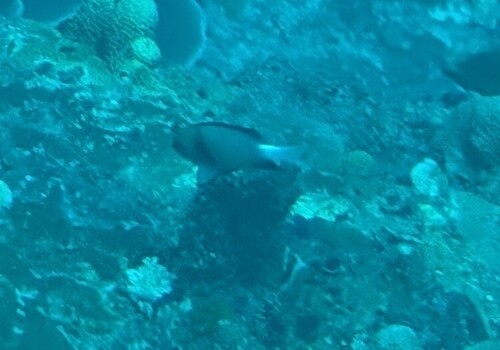
Indian Dascyllus (Dascyllus carneus)
Indian Dascyllus Dascyllus carneus A small damselfish with a pale body, a black spot on the upper side, and a black band on the tail base.to 7 cm · 1-30 m · by daycoral-rich areas of lagoons and outer reefsOften hovers in small groups above branching corals, darting into the branches for cover when approached. (c) Zac Peterson, some rights reserved (CC BY) · observation
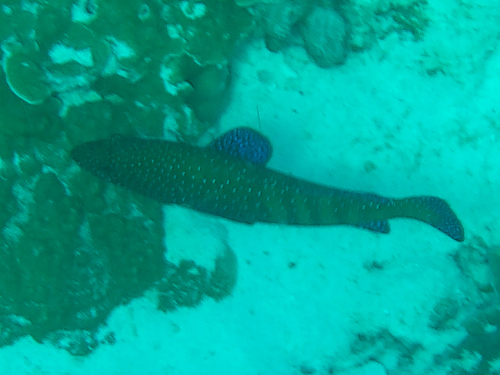
Peacock Grouper (Cephalopholis argus)
Peacock Grouper Cephalopholis argus A robust grouper with a dark brown to greenish body covered in numerous small, bright blue spots. It often hovers near shelter.to 60 cm · 1-40 m · day and nightcoral and rocky reefs, often in surge zonesLook for its distinctive blue spots in crevices or under ledges; it is often solitary but can form small groups. (c) CaracalShan, some rights reserved (CC BY) · observation
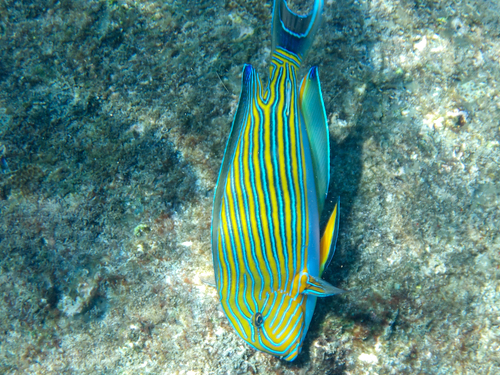
Striped Surgeonfish (Acanthurus lineatus)
Striped Surgeonfish Acanthurus lineatus A brightly striped surgeonfish with alternating blue and yellow horizontal lines on the body and a sharp, retractable spine near the tail.to 38 cm · 1-15 m · by dayshallow, turbulent surge zones on outer reef crestsOften seen in small groups grazing on algae; the tail spine is a defensive weapon, so avoid approaching too closely from behind. (c) CaracalShan, some rights reserved (CC BY) · observation
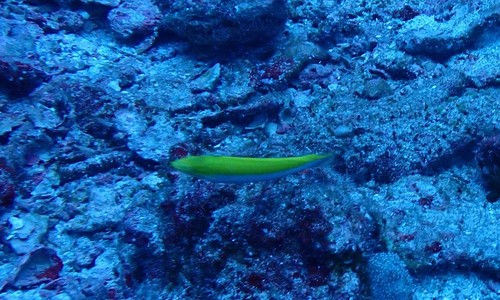
Canarytop Wrasse (Halichoeres leucoxanthus)
Canarytop Wrasse Halichoeres leucoxanthus A small, slender wrasse with a bright yellow body and a distinctive white patch on the upper back near the dorsal fin.to 9 cm · 3-30 m · by dayrubble and sand patches on outer reef slopesLook for it hovering just above the sand, darting quickly to pick at small invertebrates. (c) luluchouette, some rights reserved (CC BY) · observation