Home › Dive Sites › Indonesia › Bali › Tianyar

Tianyar

📍 Bali, Indonesia

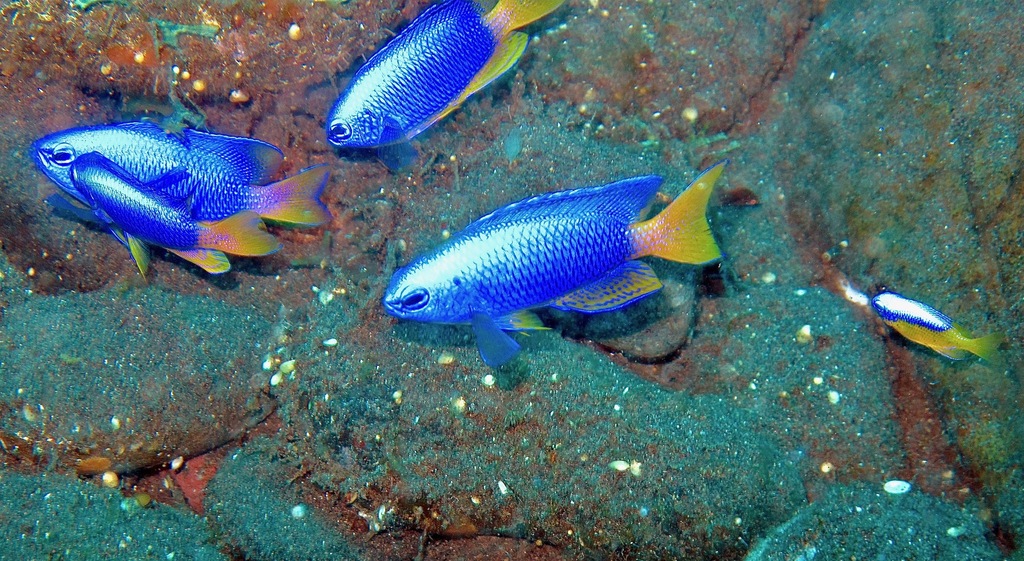
Neon Damselfish (Pomacentrus coelestis) — recorded at Tianyar

Tianyar is a dive site in Bali, Indonesia. The sea floor at the site position lies at about 35 meters. Currents typically run at 0.6 km/h and reach 1.4 km/h on the strongest days. Water temperatures range from 28°C in August to 31°C in November. The typical daily tidal range is about 1.2 m. Species recorded in the area include Neon Damselfish, Red Squirrelfish, Bubble Coral, Forceps Butterflyfish and Striped Boxfish.

Dive Conditions

⬇️
Seabed Depth
35m
💨
Current
0.6 km/h (1.4)
🌡️
Water Temp
28–31 °C

🤿 Book a Diving Tour in Tianyar

Tours powered by GetYourGuide. FindADive may earn a commission on bookings.

Typical Current 0.6 km/h (up to 1.4)
Seabed Depth 35 m
Water Temperature 28–31 °C
Tidal Range 1.2 m (typical daily)
GPS -8.1755°, 115.4725°

Data sources: currents and water temperature from Open-Meteo Marine (CC BY 4.0), hourly model values 2024; seabed depth from the GEBCO 2020 Grid, sampled at the site coordinates (grid resolution about 450 m). Tidal range is the median daily range of modelled sea level from Open-Meteo Marine, hourly values 2024. Species observations from iNaturalist, checked against the World Register of Marine Species.

Conditions at Tianyar through the year

Sea surface temperature at the site coordinates, averaged per month from hourly model values for 2024. The water is warmest in November at about 31 °C and coolest in August at about 28 °C, a spread of 2.3 degrees across the year.

Monthly sea surface temperature at Tianyar (°C)
JanFebMarAprMayJunJulAugSepOctNovDec
29.6 29.4 29.6 30.2 29.9 29.1 28.8 28.2 28.7 29.6 30.5 30.4

Ocean current at the site runs at a typical 0.6 km/h. In the strongest tenth of the hours modelled for 2024 it reaches 1.4 km/h, which is when entries are normally timed to slack water at the turn of the tide.

The tide moves the water level by a median 1.2 m over a day, and by up to 1.7 m on the largest days of the month. That range drives how much water is exchanged over the reef and when the current turns.

Offshore wave statistics are not shown for Tianyar: within 10 km of the site there is land in the directions from which 100 % of the larger waves in the area arrive, so open-sea values would overstate the swell at the site itself.

The seabed directly under the site coordinates sits at about 35 m. This is a bathymetry grid value with a cell size of roughly 450 m, so it describes the depth of the area rather than the deepest point a dive can reach.

How Tianyar compares

These comparisons use only the measured values above, set against the 376 dive sites published on findadive.com. A percentage shows the share of other sites with a lower (or higher) value, so it reads the same way wherever the site is.

Tianyar compared with all listed sites and with Bali
MeasureThis siteCompared with all sitesMedian in Bali
Mean water temperature29.5 °Cwarmer than 58 % of the other 375 sites29.1 °C (99 sites)
Water temperature in the coolest month28.2 °Cwarmer than 55 % of the other 375 sites27.8 °C (99 sites)
Typical current0.6 km/hweaker than 88 % of the other 375 sites3.2 km/h (99 sites)
Current in the strongest 10 % of hours1.4 km/hweaker than 77 % of the other 375 sites5.7 km/h (99 sites)
Median daily tidal range1.2 msmaller than 88 % of the other 375 sites1.5 m (99 sites)

Water temperature, current and tide from Open-Meteo Marine (CC BY 4.0), hourly model values for 2024 at -8.1755°, 115.4725°. Seabed depth from the GEBCO 2020 Grid. Wave statistics from ERA5-Ocean via Open-Meteo Marine (contains modified Copernicus Climate Change Service information 2015–2024), daily maximum wave height on a 0.5° grid; land shelter tested against Natural Earth coastlines.

Marine life recorded at this site

Research-grade observations from iNaturalist within about 12 km of these coordinates.
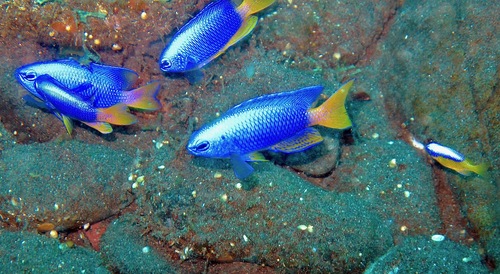
Neon Damselfish (Pomacentrus coelestis)
Neon Damselfish Pomacentrus coelestis A small, intensely blue damselfish with a yellow tail, often seen darting among coral branches.to 9 cm · 1-40 m · by dayouter reef slopes and lagoon patch reefsLook for flashes of blue among branching corals, especially Acropora; it retreats into the coral when approached. (c) Bernard DUPONT, some rights reserved (CC BY) · observation
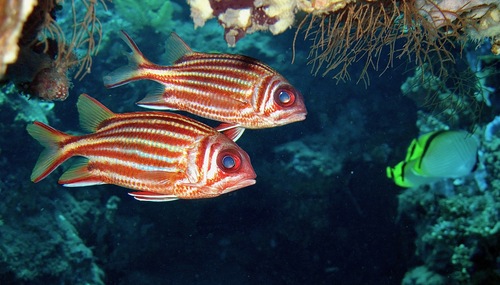
Red Squirrelfish (Sargocentron rubrum)
Red Squirrelfish Sargocentron rubrum A reddish squirrelfish with silvery-white horizontal stripes along its body and large, dark eyes.to 32 cm · 1-100 m · at nightreef caves, crevices, and under ledgesLook for its reflective eyes in dark recesses during the day; it is more active and easier to spot at night. (c) Bernard DUPONT, some rights reserved (CC BY) · observation
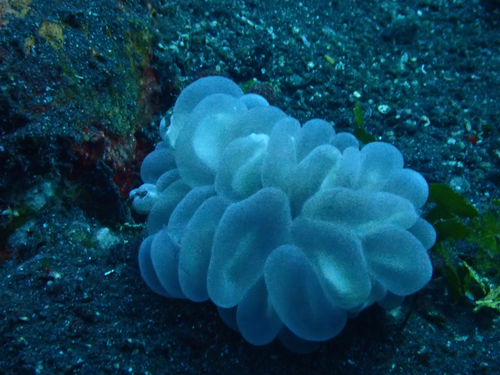
Bubble Coral (Plerogyra sinuosa)
Bubble Coral Plerogyra sinuosa A colonial coral with large, bubble-like vesicles that expand during the day to capture light for its symbiotic algae.colonies to 50 cm · 3-35 m · by dayprotected reef slopes and overhangsLook for it in shaded areas; the vesicles deflate at night, revealing a hard, branching skeleton. (c) norcalmc, some rights reserved (CC BY) · observation
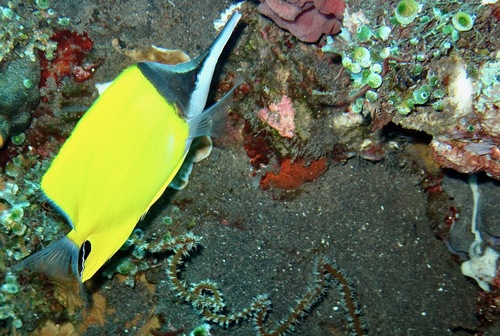
Forceps Butterflyfish (Forcipiger flavissimus)
Forceps Butterflyfish Forcipiger flavissimus A bright yellow butterflyfish with a long, slender snout and a black mask over the eyes and forehead.to 22 cm · 3-70 m · by dayouter reef slopes and channelsOften seen in pairs, picking at small invertebrates with its forceps-like mouth. (c) Bernard DUPONT, some rights reserved (CC BY) · observation
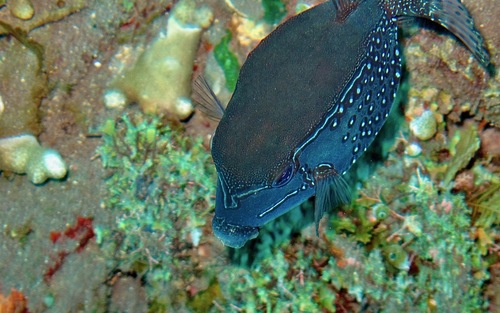
Striped Boxfish (Ostracion solorense)
Striped Boxfish Ostracion solorense A small, angular boxfish with a pale body crossed by dark brown stripes and spots, often seen hovering near the reef.to 12 cm · 5-30 m · by daycoral-rich areas of sheltered reefs and lagoonsLook for its distinctive boxy shape and striped pattern while it moves slowly among coral branches. (c) Bernard DUPONT, some rights reserved (CC BY) · observation
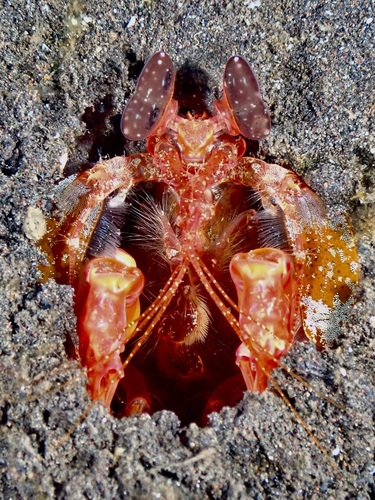
Lisa's Mantis Shrimp (Lysiosquilla lisa)
Lisa's Mantis Shrimp Lysiosquilla lisa A mantis shrimp with a pale, translucent body, often with a faint greenish or bluish tint, and large, stalked eyes. It lives in a burrow.to 10 cm · 5-30 m · day and nightsandy or silty seabedLook for a pair of antennae or a small mound of sediment with two holes; the shrimp often peers out from its burrow entrance. no rights reserved · CC0 · observation
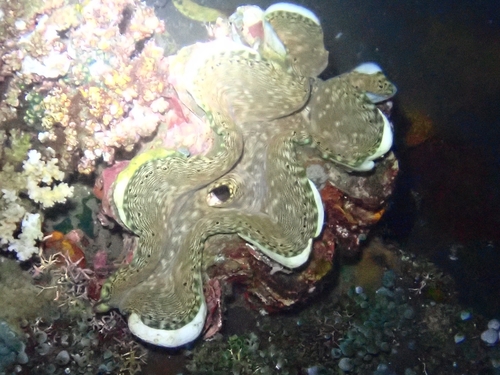
Fluted Giant Clam (Tridacna squamosa)
Fluted Giant Clam Tridacna squamosa A large bivalve with a thick, fluted shell and colourful mantle tissue that extends beyond the shell rim.to 40 cm · 2-20 m · day and nightcoral reefs, often embedded in massive corals or on hard substrateLook for the colourful mantle, which retracts quickly if a shadow passes over it. (c) Ben Costamagna, some rights reserved (CC BY) · observation
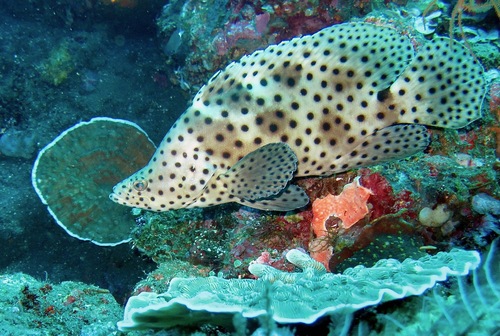
Humpback Grouper (Chromileptes altivelis)
Humpback Grouper Chromileptes altivelis A pale grouper with large, dark, widely spaced spots and a distinctive humped forehead, often seen resting on the bottom.to 70 cm · 2-40 m · day and nightsandy or silty areas near coral reefs and seagrass bedsLook for it sitting motionless on the substrate; it may allow a slow, careful approach. (c) Bernard DUPONT, some rights reserved (CC BY) · observation