Home › Dive Schools › Indonesia › Tulamben › UDIVE BALI

UDIVE BALI

PADI 5 Star IDC 📍 Tulamben, Indonesia ★★★★★ 5.0 (284 reviews)

Photo: (c) portioid, some rights reserved (CC BY) · via iNaturalist

UDIVE BALI is a PADI 5 Star IDC in Tulamben, Indonesia. The courses listed on its website include Discover Scuba Diving, Open Water Diver, Advanced Open Water Diver, Rescue Diver and Enriched Air Nitrox. It is based at Tulamben, Kubu, Karangasem Regency, Bali 80852, Indonesia.

On Google it holds an average rating of 5.0 from 284 reviews.

Sea temperatures in the surrounding waters range from 28°C in August to 30°C in November. Species recorded near these coordinates include Dragon Seamoth, Peacock Mantis Shrimp, Unidentia sandramillenae and Ocellate Phyllidia.

🤿 Book a Diving Tour in Tulamben, Indonesia

Tours powered by GetYourGuide. FindADive may earn a commission on bookings.

At a glance

  • One of 4 PADI centres listed in Tulamben (4 dive centres there in total)
  • 6 dive sites within 60 km: Usat Liberty Wreck (0 km) · Coral Garden (1 km) · Tulamben Drop Off (1 km) · Alamanda (1 km) · Batu Kelebit (2 km) · Emerald Bay (2 km)
Certification PADI 5 Star IDC
Courses offered Discover Scuba Diving, Open Water Diver, Advanced Open Water Diver, Rescue Diver, Enriched Air Nitrox
Location Tulamben, Indonesia
Address Tulamben, Kubu, Karangasem Regency, Bali 80852, Indonesia
Google Rating ★★★★★ 5.0 284 reviews
GPS -8.2747°, 115.5900°
Operator ID 5d4bb1b6-bad2-4b42-8571-f8c6774a882d

Sea temperature through the year

Average sea surface temperature at the coordinates of UDIVE BALI, Tulamben, Indonesia, by calendar month. The water is warmest in November at 30.4 °C and coldest in August at 28.0 °C, a spread of 2.4 kelvin over the year. Every month of the year averages 25 °C or more.

MonthJanFebMarAprMayJunJulAugSepOctNovDec
Sea temperature (°C)29.629.429.730.229.729.028.628.028.529.530.430.4

By season, the four quarterly averages at this location are spring (March to May) 29.9 °C, summer (June to August) 28.5 °C, autumn (September to November) 29.5 °C and winter (December to February) 29.8 °C.

Sea surface temperature from Open-Meteo Marine (CC BY 4.0), daily model means 2022-11 to 2024-12, sampled at the coordinates of this dive centre. Values are monthly averages of the daily means, not forecasts.

Marine life recorded in this area

Research-grade observations from iNaturalist near these coordinates.
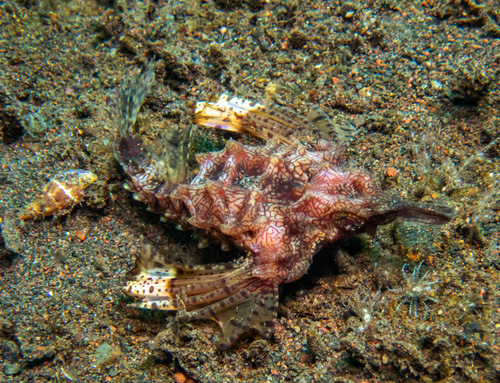
Dragon Seamoth (Eurypegasus draconis)
Dragon Seamoth Eurypegasus draconis A small, flattened fish with a boxy body and large, wing-like pectoral fins. It walks on the seabed using modified pelvic fins.to 10 cm · 3-90 m · day and nightsandy or silty bottoms, often near rubble or seagrassLook for a small, triangular shape on the sand; it may stay still, relying on camouflage, or walk away slowly. (c) portioid, some rights reserved (CC BY) · observation
Peacock Mantis Shrimp (Odontodactylus scyllarus)
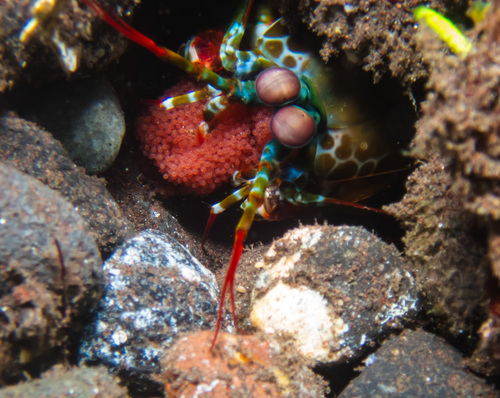
Peacock Mantis Shrimp Odontodactylus scyllarus A brightly coloured mantis shrimp with a green body, orange legs and striking blue, red and green spots on its raptorial appendages. It lives in a burrow.to 18 cm · 3-40 m · by daysandy or rubble areas near reefs, in self-made burrowsLook for a neat, round burrow entrance; the shrimp often sits at the entrance, watching. (c) portioid, some rights reserved (CC BY) · observation
Unidentia sandramillenae (Unidentia sandramillenae)
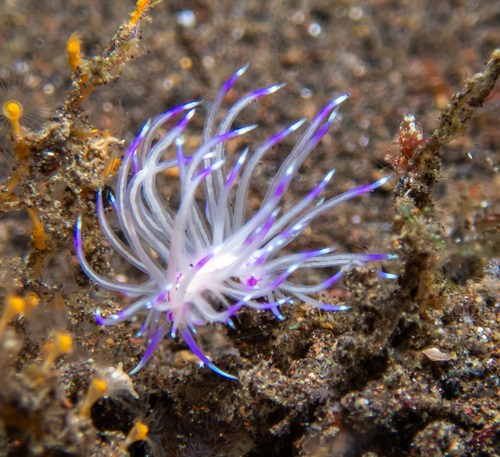
Unidentia sandramillenae Unidentia sandramillenae A small, translucent nudibranch with a white-edged mantle and scattered orange spots, often seen crawling on algae.to 2 cm · 5-20 m · day and nightalgae-covered rocks and rubbleLook closely on algae fronds; its pale colour and small size make it easy to miss. (c) portioid, some rights reserved (CC BY) · observation
Ocellate Phyllidia (Phyllidia ocellata)
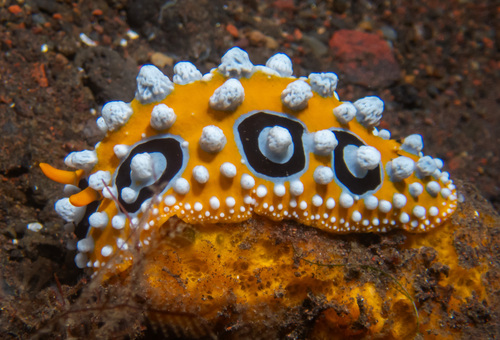
Ocellate Phyllidia Phyllidia ocellata A nudibranch with a yellow body covered in black-tipped, blue-grey tubercles and distinctive black rings with yellow centres.to 6 cm · 5-30 m · day and nightcoral and rocky reefs, often on spongesLook for its bright pattern on reef surfaces and sponges; it moves slowly, allowing for close observation. (c) portioid, some rights reserved (CC BY) · observation