Home › Dive Sites › Indonesia › Bali › Gili Selang

Gili Selang

📍 Bali, Indonesia

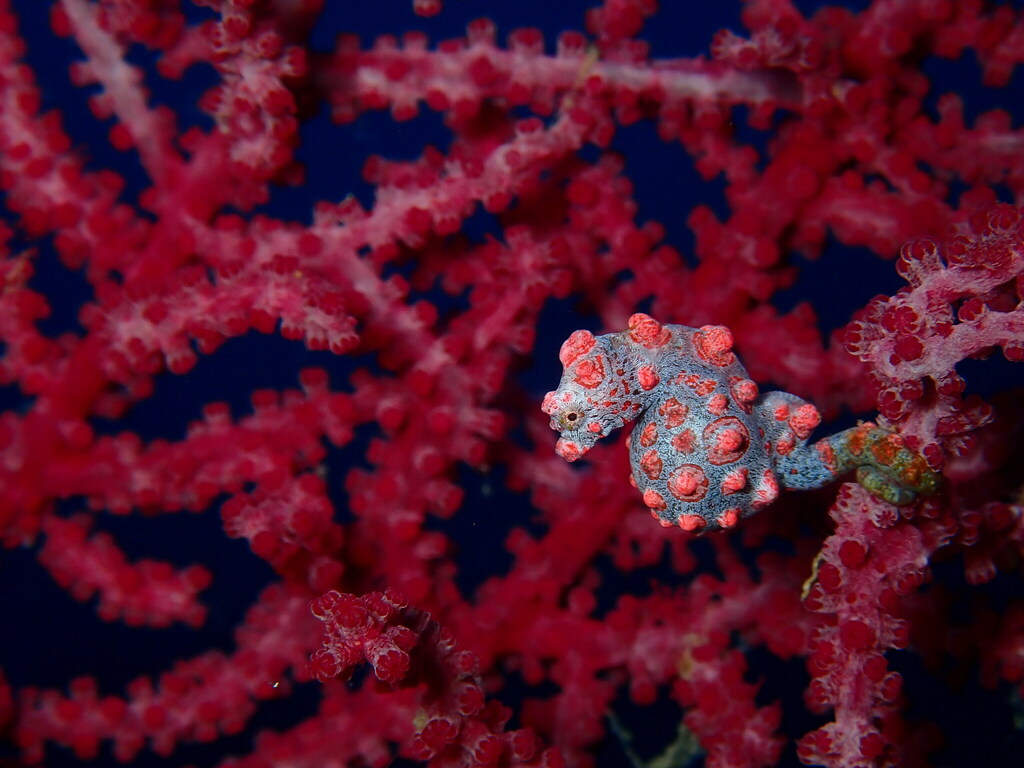
Pygmy Seahorse (Hippocampus bargibanti) — recorded at Gili Selang

Gili Selang is a dive site in Bali, Indonesia. Currents typically run at 4.1 km/h and reach 6 km/h on the strongest days. Water temperatures range from 28°C in August to 30°C in December. The typical daily tidal range is about 1.3 m. Species recorded in the area include Pygmy Seahorse, Bluespotted Puffer, Redfin Butterflyfish, Goniobranchus setoensis and Lagoon Triggerfish.

Dive Conditions

💨
Current
4.1 km/h (6.0)
🌡️
Water Temp
28–30 °C

🤿 Book a Diving Tour in Gili Selang

Tours powered by GetYourGuide. FindADive may earn a commission on bookings.

Typical Current 4.1 km/h (up to 6.0)
Water Temperature 28–30 °C
Tidal Range 1.3 m (typical daily)
GPS -8.4010°, 115.7125°

Data sources: currents and water temperature from Open-Meteo Marine (CC BY 4.0), hourly model values 2024. Tidal range is the median daily range of modelled sea level from Open-Meteo Marine, hourly values 2024. Species observations from iNaturalist, checked against the World Register of Marine Species.

Conditions at Gili Selang through the year

Sea surface temperature at the site coordinates, averaged per month from hourly model values for 2024. The water is warmest in December at about 30 °C and coolest in August at about 28 °C, a spread of 1.9 degrees across the year.

Monthly sea surface temperature at Gili Selang (°C)
JanFebMarAprMayJunJulAugSepOctNovDec
29.2 29.3 29.1 29.1 29.1 28.8 28.4 27.8 28.0 28.6 29.5 29.7

Ocean current at the site runs at a typical 4.1 km/h. In the strongest tenth of the hours modelled for 2024 it reaches 6.0 km/h, which is when entries are normally timed to slack water at the turn of the tide.

The tide moves the water level by a median 1.3 m over a day, and by up to 1.9 m on the largest days of the month. That range drives how much water is exchanged over the reef and when the current turns.

In the open sea off Gili Selang, the highest wave of the day exceeded 1.5 m on 3.7 % of days between 2015 and 2024. The roughest month was July (10 % of days), the calmest November (0 %).

Share of days with waves above 1.5 m, open sea near Gili Selang (%, 2015–2024)
JanFebMarAprMayJunJulAugSepOctNovDec
2131371084201

Satellite habitat mapping places Gili Selang on an outer reef slope, over a seabed mapped as coral and algae. The classification comes from the nearest mapped reef polygon, about 35 m from the listed coordinates, so it describes the reef the site sits on rather than a single point on it.

How Gili Selang compares

These comparisons use only the measured values above, set against the 376 dive sites published on findadive.com. A percentage shows the share of other sites with a lower (or higher) value, so it reads the same way wherever the site is. Gili Selang sits with its typical current in the top tenth of all listed sites.

Gili Selang compared with all listed sites and with Bali
MeasureThis siteCompared with all sitesMedian in Bali
Mean water temperature28.9 °Ccooler than 79 % of the other 375 sites29.1 °C (99 sites)
Water temperature in the coolest month27.8 °Ccooler than 80 % of the other 375 sites27.8 °C (99 sites)
Typical current4.1 km/hstronger than 97 % of the other 375 sites3.2 km/h (99 sites)
Current in the strongest 10 % of hours6.0 km/hstronger than 88 % of the other 375 sites5.7 km/h (99 sites)
Median daily tidal range1.3 msmaller than 58 % of the other 375 sites1.5 m (99 sites)

Water temperature, current and tide from Open-Meteo Marine (CC BY 4.0), hourly model values for 2024 at -8.4010°, 115.7125°. Wave statistics from ERA5-Ocean via Open-Meteo Marine (contains modified Copernicus Climate Change Service information 2015–2024), daily maximum wave height on a 0.5° grid; land shelter tested against Natural Earth coastlines. Reef structure and seabed cover from the Allen Coral Atlas © 2018–2023 Allen Coral Atlas Partnership and Arizona State University (CC BY 4.0).

Marine life recorded at this site

Research-grade observations from iNaturalist within about 12 km of these coordinates.

Pygmy Seahorse (Hippocampus bargibanti)
Pygmy Seahorse Hippocampus bargibanti A tiny seahorse with a pink or yellow body covered in tubercles, perfectly camouflaged on its host gorgonian.to 2.4 cm · 16-40 m · day and nightgorgonian sea fans, especially Muricella speciesScan gorgonian fans slowly and closely; look for a small, rounded shape that matches the polyps. (c) Rachel Crane, some rights reserved (CC BY) · observation
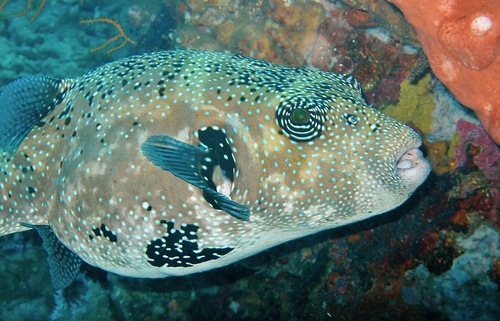
Bluespotted Puffer (Arothron caeruleopunctatus)
Bluespotted Puffer Arothron caeruleopunctatus A pufferfish with a greyish-brown body densely covered in small blue spots. It has a blunt head and can inflate its body when threatened.to 80 cm · 1-30 m · by dayreef flats, slopes and lagoons, often near rubble or sandLook for it cruising slowly over the reef; it is often solitary and may allow a slow approach. (c) Bernard DUPONT, some rights reserved (CC BY) · observation
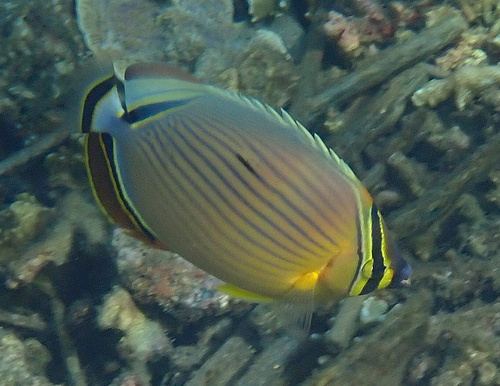
Redfin Butterflyfish (Chaetodon lunulatus)
Redfin Butterflyfish Chaetodon lunulatus A butterflyfish with a white body, yellow tail and dorsal fin, and a distinctive black band through the eye. The pelvic and anal fins are bright red-orange.to 15 cm · 1-30 m · by daycoral-rich areas of reef flats, lagoons, and seaward reefsOften seen in pairs; look for the red fins and the black eye band while it feeds on coral polyps. (c) Jan Ebr & Ivana Ebrová, some rights reserved (CC BY) · observation
Goniobranchus setoensis (Goniobranchus setoensis)
Goniobranchus setoensis Goniobranchus setoensis A small nudibranch with a translucent white body and a pattern of orange or yellow spots and lines on its mantle.to 2.5 cm · 5-20 m · day and nightsandy or rubble areas near spongesLook closely on the undersides of rocks or on sponges; its small size and pale colour make it easy to miss. (c) Heine Jensen, some rights reserved (CC BY) · observation
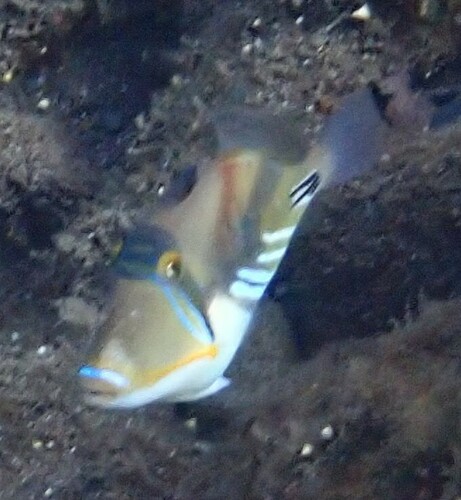
Lagoon Triggerfish (Rhinecanthus aculeatus)
Lagoon Triggerfish Rhinecanthus aculeatus A stocky triggerfish with a complex pattern of dark lines and a pale belly, known for its territorial behaviour and strong jaws.to 30 cm · 1-50 m · by dayshallow lagoons, reef flats, and seaward reefsOften hovers over a sandy patch near its nest; divers who approach too closely may be charged. (c) Jan Ebr & Ivana Ebrová, some rights reserved (CC BY) · observation
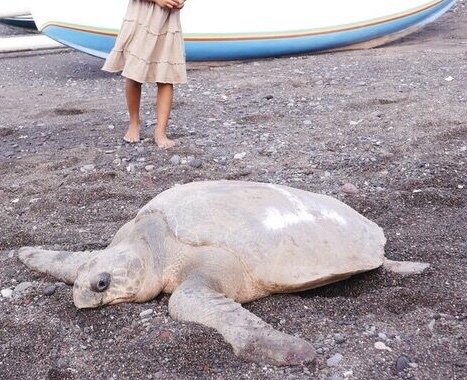
Olive Ridley Sea Turtle (Lepidochelys olivacea)
Olive Ridley Sea Turtle Lepidochelys olivacea A medium-sized sea turtle with a heart-shaped carapace, olive-grey in colour, often seen swimming or resting on the seabed.to 70 cm carapace · surface to 150 m · day and nightcoastal waters, reefs, and sandy bottomsRemain still and avoid sudden movements; it may continue its activity or rest if not disturbed. (c) Justine, some rights reserved (CC BY) · observation
Golden Rabbitfish (Siganus guttatus)
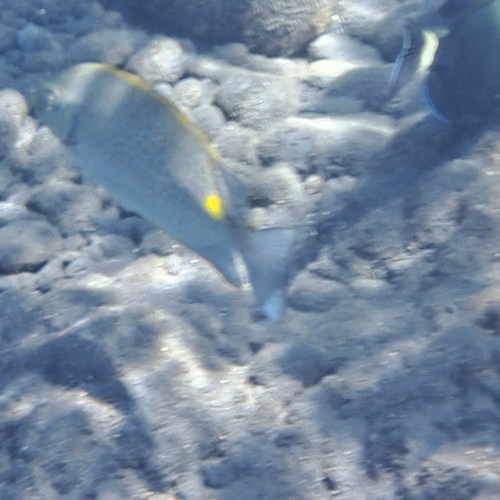
Golden Rabbitfish Siganus guttatus A deep-bodied, yellowish fish with numerous small blue spots on its upper body and a distinctive golden patch behind the gill cover.to 40 cm · 3-30 m · day and nightcoastal reefs, often near seagrass beds or mangrovesOften seen in small schools; look for the bright golden shoulder patch and blue spots in clear water. (c) marisnocatpiss, some rights reserved (CC BY) · observation
Mimic Surgeonfish (Acanthurus pyroferus)
Mimic Surgeonfish Acanthurus pyroferus A surgeonfish that mimics the colour patterns of juvenile angelfish, with a dark body and a yellow patch near the tail.to 25 cm · 2-30 m · by dayouter reef slopes and lagoonsLook for it near coral outcrops, often solitary or in small groups; its mimicry changes as it matures. (c) marisnocatpiss, some rights reserved (CC BY) · observation