Home › Dive Sites › Indonesia › Lombok › Setangi Rock

Setangi Rock

📍 Lombok, Indonesia

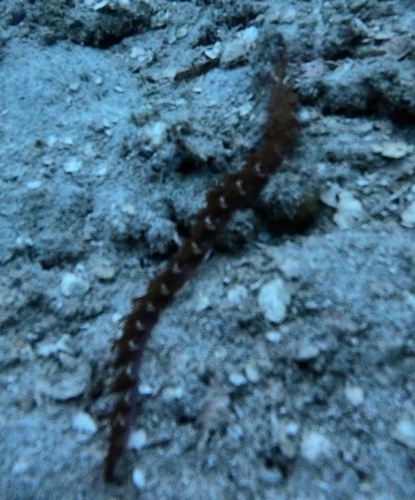
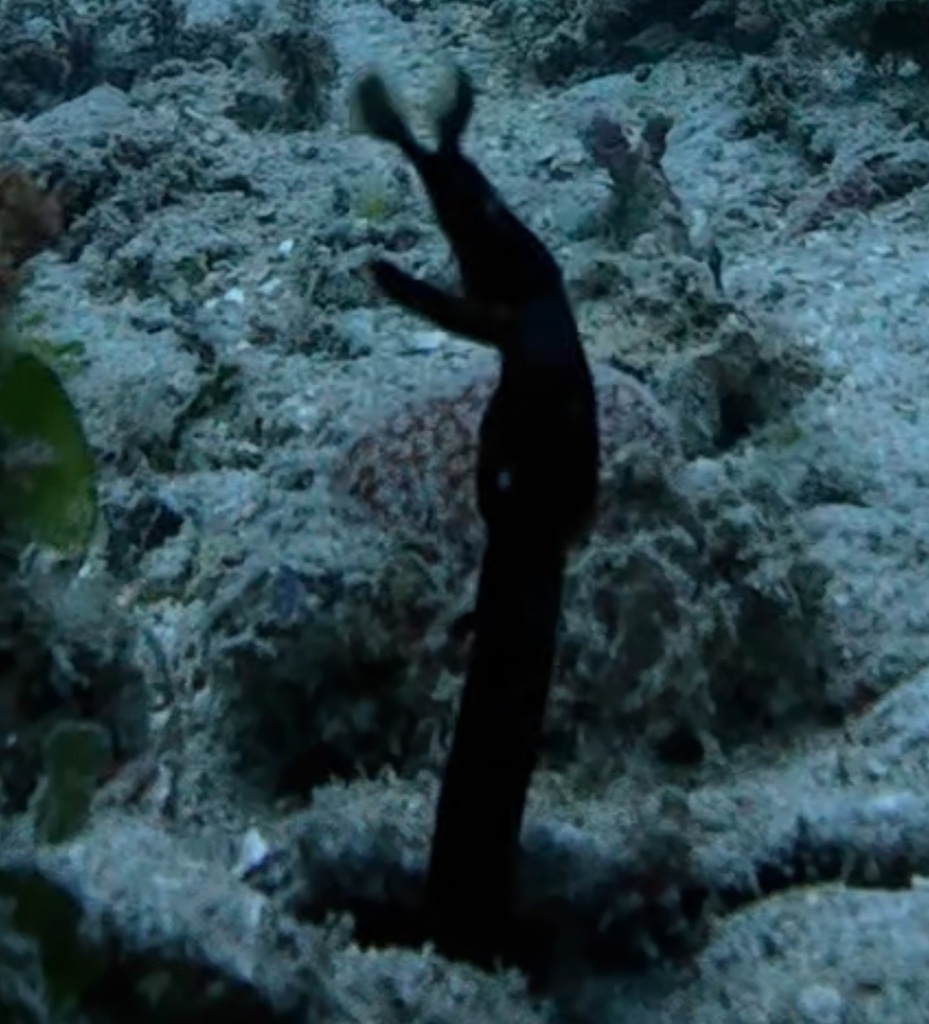
Ribbon Eel (Rhinomuraena quaesita) — recorded at Setangi Rock

Setangi Rock is a dive site in Lombok, Indonesia. Currents typically run at 2.1 km/h and reach 3.5 km/h on the strongest days. Water temperatures range from 28°C in August to 30°C in November. The typical daily tidal range is about 1.3 m. Species recorded in the area include Ribbon Eel, Blue Dragon, Freckled Hawkfish, Blackspotted Puffer and Spotted Boxfish.

Dive Conditions

💨
Current
2.1 km/h (3.5)
🌡️
Water Temp
28–30 °C

🤿 Book a Diving Tour in Setangi Rock

Tours powered by GetYourGuide. FindADive may earn a commission on bookings.

Typical Current 2.1 km/h (up to 3.5)
Water Temperature 28–30 °C
Tidal Range 1.3 m (typical daily)
GPS -8.4776°, 116.0211°

Data sources: currents and water temperature from Open-Meteo Marine (CC BY 4.0), hourly model values 2024. Tidal range is the median daily range of modelled sea level from Open-Meteo Marine, hourly values 2024. Species observations from iNaturalist, checked against the World Register of Marine Species.

Conditions at Setangi Rock through the year

Sea surface temperature at the site coordinates, averaged per month from hourly model values for 2024. The water is warmest in November at about 30 °C and coolest in August at about 28 °C, a spread of 2.1 degrees across the year.

Monthly sea surface temperature at Setangi Rock (°C)
JanFebMarAprMayJunJulAugSepOctNovDec
29.4 29.3 29.7 30.1 29.8 29.0 28.6 28.1 28.5 29.1 30.2 29.9

Ocean current at the site runs at a typical 2.1 km/h. In the strongest tenth of the hours modelled for 2024 it reaches 3.5 km/h, which is when entries are normally timed to slack water at the turn of the tide.

The tide moves the water level by a median 1.3 m over a day, and by up to 1.8 m on the largest days of the month. That range drives how much water is exchanged over the reef and when the current turns.

In the open sea off Setangi Rock, the highest wave of the day exceeded 1.5 m on 2.0 % of days between 2015 and 2024. The roughest month was July (5 % of days), the calmest April (0 %).

Share of days with waves above 1.5 m, open sea near Setangi Rock (%, 2015–2024)
JanFebMarAprMayJunJulAugSepOctNovDec
223014541101

How Setangi Rock compares

These comparisons use only the measured values above, set against the 376 dive sites published on findadive.com. A percentage shows the share of other sites with a lower (or higher) value, so it reads the same way wherever the site is.

Setangi Rock compared with all listed sites and with Lombok
MeasureThis siteCompared with all sitesMedian in Lombok
Mean water temperature29.3 °Ccooler than 64 % of the other 375 sites29.4 °C (44 sites)
Water temperature in the coolest month28.1 °Ccooler than 54 % of the other 375 sites28.2 °C (44 sites)
Typical current2.1 km/hstronger than 66 % of the other 375 sites1.8 km/h (44 sites)
Current in the strongest 10 % of hours3.5 km/hstronger than 63 % of the other 375 sites3.2 km/h (44 sites)
Median daily tidal range1.3 msmaller than 69 % of the other 375 sites1.2 m (44 sites)

Water temperature, current and tide from Open-Meteo Marine (CC BY 4.0), hourly model values for 2024 at -8.4776°, 116.0211°. Wave statistics from ERA5-Ocean via Open-Meteo Marine (contains modified Copernicus Climate Change Service information 2015–2024), daily maximum wave height on a 0.5° grid; land shelter tested against Natural Earth coastlines.

Marine life recorded at this site

Research-grade observations from iNaturalist within about 12 km of these coordinates.
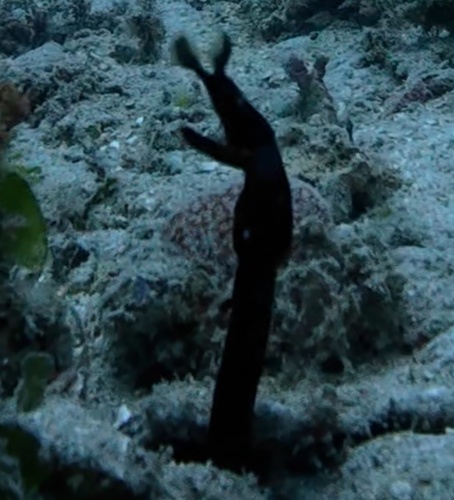
Ribbon Eel (Rhinomuraena quaesita)
Ribbon Eel Rhinomuraena quaesita A long, slender eel with a prominent, leaf-like nostril. Juveniles are black with a yellow dorsal fin; males are blue with yellow jaws; females are yellow.to 130 cm · 1-60 m · day and nightburrows in sandy or rubble bottoms near reefsLook for its head protruding from a burrow; it rarely emerges fully and retreats quickly if disturbed. no rights reserved · CC0 · observation
Blue Dragon (Pteraeolidia semperi)
Blue Dragon Pteraeolidia semperi A slender nudibranch with long, branching cerata covering its back, giving it a feathery appearance. The cerata contain photosynthetic algae, which can give the animal a greenish hue.to 5 cm · 5-25 m · day and nightcoral rubble and reef slopesLook closely on hydroids and bryozoans, its food source; its cerata can retract when disturbed. no rights reserved · CC0 · observation
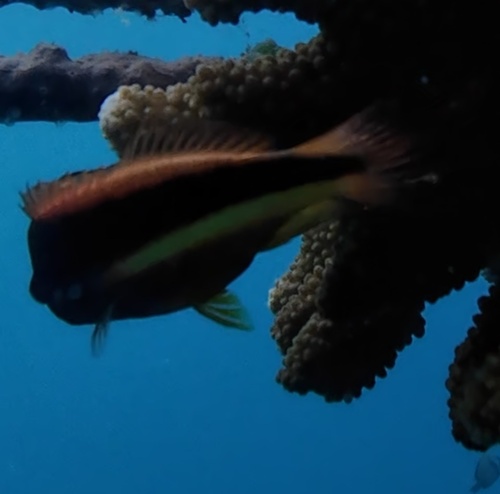
Freckled Hawkfish (Paracirrhites forsteri)
Freckled Hawkfish Paracirrhites forsteri A robust hawkfish with a variable colour pattern, often reddish-brown with small white spots on the head and body, perched on coral.to 22 cm · 1-40 m · by dayexposed coral heads or rocky outcropsLook for it sitting motionless on the highest point of a coral head, scanning for prey. no rights reserved · CC0 · observation
Blackspotted Puffer (Arothron nigropunctatus)
Blackspotted Puffer Arothron nigropunctatus A robust, pale grey to yellowish pufferfish covered in small black spots and blotches. It has a rounded body and large eyes.to 33 cm · 1-25 m · day and nightcoral-rich areas of lagoons and seaward reefsOften seen hovering motionless near coral heads. It may inflate if approached too closely or handled. (c) Jan Ebr & Ivana Ebrová, some rights reserved (CC BY) · observation
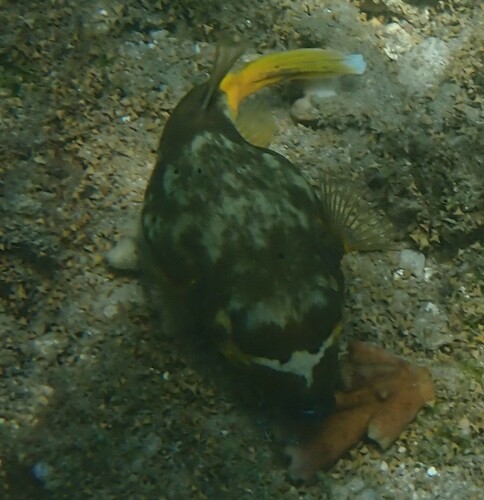
Spotted Boxfish (Ostracion meleagris)
Spotted Boxfish Ostracion meleagris A small, square-shaped fish with a rigid body covered in bony plates. Its colour varies from black with white spots to yellow with black spots.to 25 cm · 1-30 m · by daycoral-rich areas of lagoons and seaward reefsWatch for its slow, hovering swimming motion, often near coral heads or over rubble patches. (c) Kelvin Perrie, some rights reserved (CC BY) · observation
Dashed-line Blenny (Blenniella interrupta)
Dashed-line Blenny Blenniella interrupta A small, slender blenny with a series of short dark dashes along its side, often perching on rocks or rubble.to 8 cm · 0-10 m · by dayshallow reef flats and rocky intertidal zonesLook for it resting on bare rock surfaces or in small depressions, often flicking its dorsal fin. (c) Kelvin Perrie, some rights reserved (CC BY) · observation
Shireen's Phyllidiopsis (Phyllidiopsis shireenae)
Shireen's Phyllidiopsis Phyllidiopsis shireenae A nudibranch with a black body covered in large, rounded pink tubercles, often with a white margin. It crawls slowly on the reef.to 5 cm · 5-30 m · day and nightcoral and rocky reefs, often on spongesLook for its distinctive pink and black pattern on reef surfaces and overhangs, moving very slowly. (c) Dan Schofield, some rights reserved (CC BY) · observation
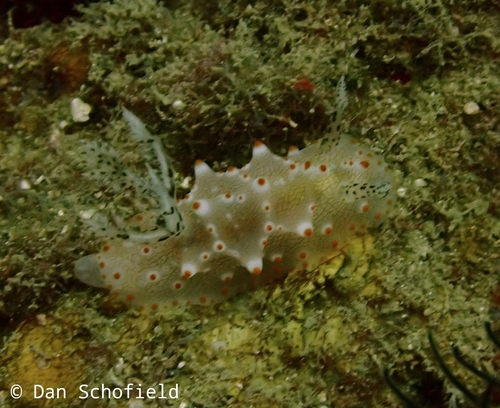
Batangas Halgerda (Halgerda batangas)
Batangas Halgerda Halgerda batangas A nudibranch with a white body covered in a network of raised orange lines and black spots, and a frilly mantle margin.to 5 cm · 10-30 m · day and nightsponges and shaded reef slopesLook for its distinctive pattern on sponges, often in shaded areas or under ledges. (c) Dan Schofield, some rights reserved (CC BY) · observation