Home › Dive Sites › Thailand › Phuket › Racha Noi West Side

Racha Noi West Side

📍 Phuket, Thailand

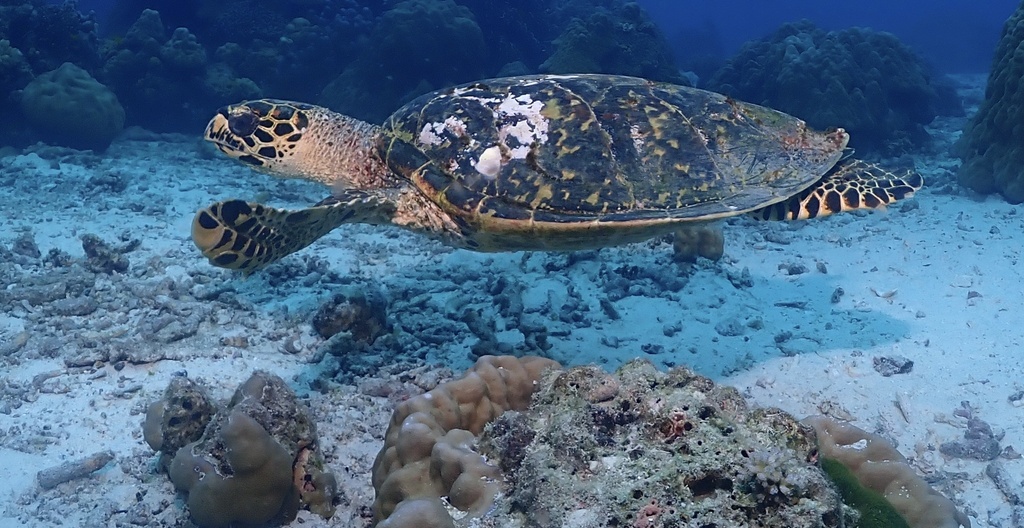
Hawksbill Sea Turtle (Eretmochelys imbricata) — recorded at Racha Noi West Side

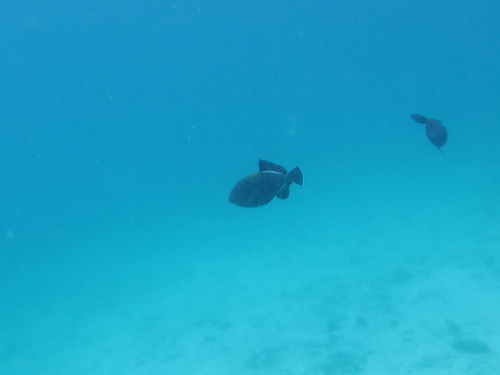
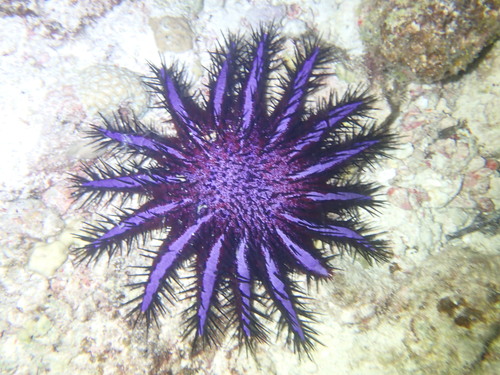
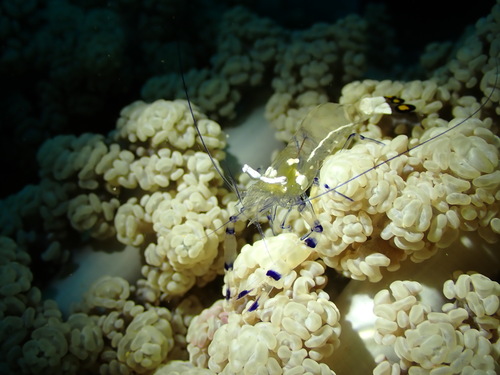
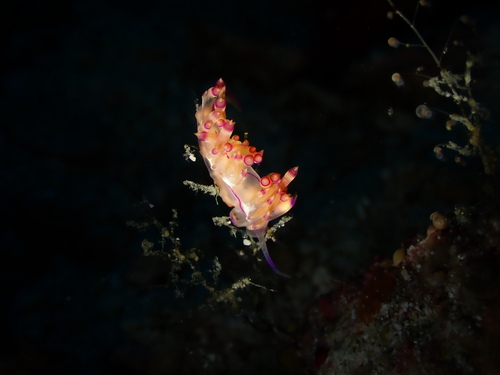
Racha Noi West Side is a dive site in Phuket, Thailand. The sea floor at the site position lies at about 28 meters. Currents typically run at 1 km/h and reach 2 km/h on the strongest days. Water temperatures range from 29°C in January to 31°C in May. The typical daily tidal range is about 1.7 m. Species recorded in the area include Hawksbill Sea Turtle, Black-finned Triggerfish, Long-spined Crown-of-Thorns, Peacock-tail Anemone Shrimp and Coryphellina flamma.

Dive Conditions

⬇️
Seabed Depth
28m
💨
Current
1.0 km/h (2.0)
🌡️
Water Temp
29–31 °C

🤿 Book a Diving Tour in Racha Noi West Side

Tours powered by GetYourGuide. FindADive may earn a commission on bookings.

Typical Current 1.0 km/h (up to 2.0)
Seabed Depth 28 m
Water Temperature 29–31 °C
Tidal Range 1.7 m (typical daily)
GPS 7.5186°, 98.3227°

Data sources: currents and water temperature from Open-Meteo Marine (CC BY 4.0), hourly model values 2024; seabed depth from the GEBCO 2020 Grid, sampled at the site coordinates (grid resolution about 450 m). Tidal range is the median daily range of modelled sea level from Open-Meteo Marine, hourly values 2024. Species observations from iNaturalist, checked against the World Register of Marine Species.

Conditions at Racha Noi West Side through the year

Sea surface temperature at the site coordinates, averaged per month from hourly model values for 2024. The water is warmest in May at about 31 °C and coolest in January at about 29 °C, a spread of 2.4 degrees across the year.

Monthly sea surface temperature at Racha Noi West Side (°C)
JanFebMarAprMayJunJulAugSepOctNovDec
28.8 29.2 29.8 30.7 31.2 30.5 30.0 30.0 29.3 29.7 29.8 29.2

Ocean current at the site runs at a typical 1.0 km/h. In the strongest tenth of the hours modelled for 2024 it reaches 2.0 km/h, which is when entries are normally timed to slack water at the turn of the tide.

The tide moves the water level by a median 1.7 m over a day, and by up to 2.3 m on the largest days of the month. That range drives how much water is exchanged over the reef and when the current turns.

In the open sea off Racha Noi West Side, the highest wave of the day exceeded 1.5 m on 5.9 % of days between 2015 and 2024. The roughest month was August (19 % of days), the calmest March (0 %).

Share of days with waves above 1.5 m, open sea near Racha Noi West Side (%, 2015–2024)
JanFebMarAprMayJunJulAugSepOctNovDec
100046171914800

The seabed directly under the site coordinates sits at about 28 m. This is a bathymetry grid value with a cell size of roughly 450 m, so it describes the depth of the area rather than the deepest point a dive can reach.

How Racha Noi West Side compares

These comparisons use only the measured values above, set against the 376 dive sites published on findadive.com. A percentage shows the share of other sites with a lower (or higher) value, so it reads the same way wherever the site is.

Racha Noi West Side compared with all listed sites and with Phuket
MeasureThis siteCompared with all sitesMedian in Phuket
Mean water temperature29.8 °Cwarmer than 81 % of the other 375 sites29.8 °C (27 sites)
Water temperature in the coolest month28.8 °Cwarmer than 80 % of the other 375 sites28.8 °C (27 sites)
Typical current1.0 km/hweaker than 52 % of the other 375 sites0.9 km/h (27 sites)
Current in the strongest 10 % of hours2.0 km/hweaker than 59 % of the other 375 sites2.0 km/h (27 sites)
Median daily tidal range1.7 mlarger than 73 % of the other 375 sites1.7 m (27 sites)

Water temperature, current and tide from Open-Meteo Marine (CC BY 4.0), hourly model values for 2024 at 7.5186°, 98.3227°. Seabed depth from the GEBCO 2020 Grid. Wave statistics from ERA5-Ocean via Open-Meteo Marine (contains modified Copernicus Climate Change Service information 2015–2024), daily maximum wave height on a 0.5° grid; land shelter tested against Natural Earth coastlines.

Marine life recorded at this site

Research-grade observations from iNaturalist within about 12 km of these coordinates.
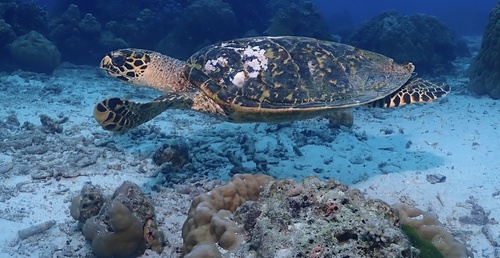
Hawksbill Sea Turtle (Eretmochelys imbricata)
Hawksbill Sea Turtle Eretmochelys imbricata A sea turtle with a distinctive pointed beak and overlapping scutes on its carapace, often seen grazing on sponges.to 1 m · 0-30 m · day and nightcoral reefs and rocky areasObserve from a distance; it may surface to breathe and then return to feed on the reef. no rights reserved · CC0 · observation
Black-finned Triggerfish (Melichthys indicus)
Black-finned Triggerfish Melichthys indicus A dark triggerfish with a pale blue line along the dorsal fin base and a black tail fin. It often swims high above the reef.to 30 cm · 5-40 m · by dayouter reef slopes and channelsLook for it hovering alone or in small groups above the reef crest, often facing into the current. (c) Jakkarin Burananit, some rights reserved (CC BY) · observation
Long-spined Crown-of-Thorns (Acanthaster planci)
Long-spined Crown-of-Thorns Acanthaster planci A large starfish with many long, sharp spines, often seen feeding on coral polyps, leaving behind white feeding scars.to 80 cm diameter · 0-30 m · at nightcoral reefs, often on stony coralsLook for white patches on coral heads at night; the starfish is often found on or near them. (c) Jakkarin Burananit, some rights reserved (CC BY) · observation
Peacock-tail Anemone Shrimp (Ancylocaris brevicarpalis)
Peacock-tail Anemone Shrimp Ancylocaris brevicarpalis A small, transparent shrimp with large white spots and a fan-like tail that is often held upright, living on host anemones.to 2.5 cm · 1-30 m · day and nighton the tentacles or oral disc of host anemonesLook closely on anemones, especially near the base; its transparent body and spots make it cryptic against the tentacles. (c) Jakkarin Burananit, some rights reserved (CC BY) · observation
Coryphellina flamma (Coryphellina flamma)
Coryphellina flamma Coryphellina flamma A small nudibranch with a translucent white body and numerous orange-tipped cerata that give it a fiery appearance.to 3 cm · 5-25 m · day and nightsponges and hydroids on reef walls and slopesLook closely on small sponges and hydroid colonies; its bright cerata can resemble the polyps of its prey. (c) Jakkarin Burananit, some rights reserved (CC BY) · observation
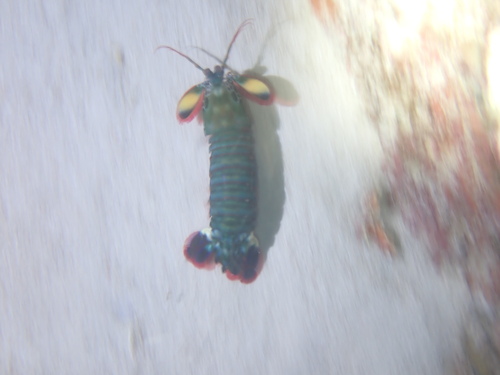
Peacock Mantis Shrimp (Odontodactylus scyllarus)
Peacock Mantis Shrimp Odontodactylus scyllarus A brightly coloured mantis shrimp with a green body, orange legs and striking blue, red and green spots on its raptorial appendages. It lives in a burrow.to 18 cm · 3-40 m · by daysandy or rubble areas near reefs, in self-made burrowsLook for a neat, round burrow entrance; the shrimp often sits at the entrance, watching. (c) Jakkarin Burananit, some rights reserved (CC BY) · observation
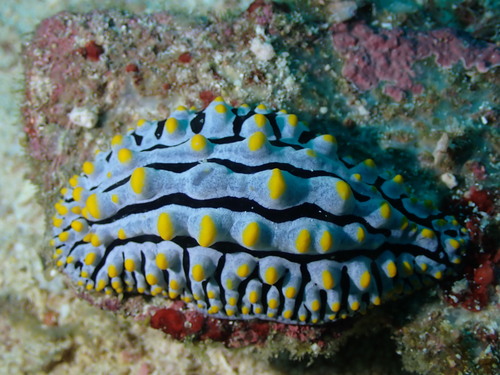
Varicose Wart Slug (Phyllidia varicosa)
Varicose Wart Slug Phyllidia varicosa A nudibranch with a black body covered in bright yellow or orange tubercles, often forming ridges. It has a distinctive pattern of yellow spots on its rhinophores and gills.to 12 cm · 5-40 m · day and nightcoral and rocky reefs, often on spongesLook for its bright warning colours on reef slopes and overhangs, often moving slowly across the substrate. (c) Jakkarin Burananit, some rights reserved (CC BY) · observation
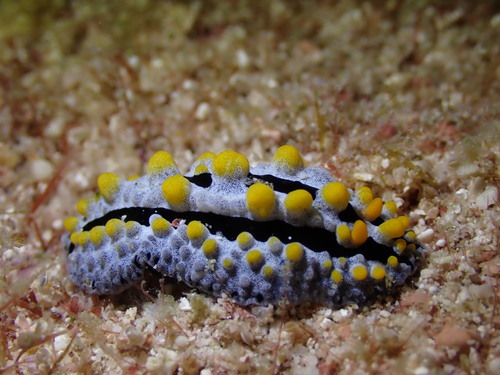
Sky Blue Phyllidia (Phyllidia coelestis)
Sky Blue Phyllidia Phyllidia coelestis A nudibranch with a bright blue body covered in raised yellow or white tubercles, often seen crawling on the reef.to 6 cm · 5-30 m · day and nighthard coral and rocky reef surfacesLook for the distinctive blue and yellow pattern on reef crests and slopes; it moves slowly. (c) Jakkarin Burananit, some rights reserved (CC BY) · observation