Home › Dive Sites › Indonesia › Komodo › End Of The World

End Of The World

📍 Komodo, Indonesia

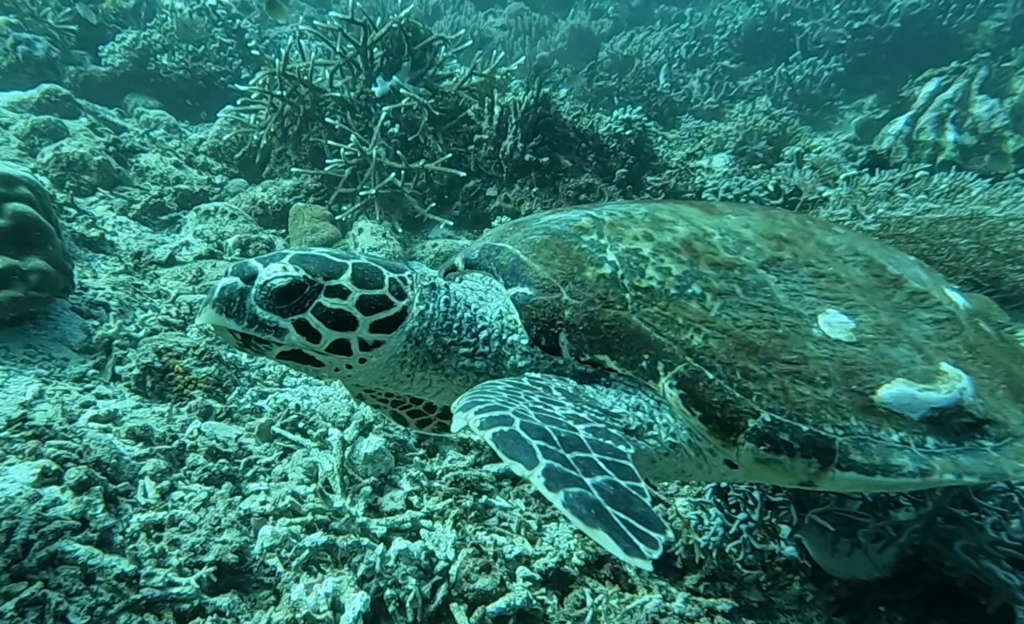
Hawksbill Sea Turtle (Eretmochelys imbricata) — recorded at End Of The World

End Of The World is a dive site in Komodo, Indonesia. It lies within the Komodo National Park. Currents typically run at 0.9 km/h and reach 2.3 km/h on the strongest days. Water temperatures range from 27°C in July to 30°C in March. The typical daily tidal range is about 2.1 m. Species recorded in the area include Hawksbill Sea Turtle, Blotched Fantail Ray, Reef Manta Ray, Soft Coral Crab and Staghorn Damsel.

Dive Conditions

💨
Current
0.9 km/h (2.3)
🌡️
Water Temp
27–30 °C

🤿 Book a Diving Tour in End Of The World

Tours powered by GetYourGuide. FindADive may earn a commission on bookings.

Typical Current 0.9 km/h (up to 2.3)
Water Temperature 27–30 °C
Tidal Range 2.1 m (typical daily)
Protected Area Komodo National Park
GPS -8.7663°, 119.4317°

Data sources: currents and water temperature from Open-Meteo Marine (CC BY 4.0), hourly model values 2024. Tidal range is the median daily range of modelled sea level from Open-Meteo Marine, hourly values 2024. Protected area boundary from OpenStreetMap contributors (ODbL). Species observations from iNaturalist, checked against the World Register of Marine Species.

Conditions at End Of The World through the year

Sea surface temperature at the site coordinates, averaged per month from hourly model values for 2024. The water is warmest in March at about 30 °C and coolest in July at about 27 °C, a spread of 2.9 degrees across the year.

Monthly sea surface temperature at End Of The World (°C)
JanFebMarAprMayJunJulAugSepOctNovDec
29.7 29.8 30.1 29.4 28.6 28.2 27.2 27.2 27.7 28.5 29.8 29.9

Ocean current at the site runs at a typical 0.9 km/h. In the strongest tenth of the hours modelled for 2024 it reaches 2.3 km/h, which is when entries are normally timed to slack water at the turn of the tide.

The tide moves the water level by a median 2.1 m over a day, and by up to 2.9 m on the largest days of the month. That range drives how much water is exchanged over the reef and when the current turns.

In the open sea off End Of The World, the highest wave of the day exceeded 1.5 m on 9.4 % of days between 2015 and 2024. The roughest month was July (31 % of days), the calmest November (0 %).

Share of days with waves above 1.5 m, open sea near End Of The World (%, 2015–2024)
JanFebMarAprMayJunJulAugSepOctNovDec
9432102431167303

End Of The World lies inside Komodo National Park. Protected areas can carry their own rules on entry fees, permits, anchoring and fishing; check the current rules with a local operator before you dive.

How End Of The World compares

These comparisons use only the measured values above, set against the 376 dive sites published on findadive.com. A percentage shows the share of other sites with a lower (or higher) value, so it reads the same way wherever the site is. End Of The World sits with its tidal range in the top tenth of all listed sites.

End Of The World compared with all listed sites and with Komodo
MeasureThis siteCompared with all sitesMedian in Komodo
Mean water temperature28.8 °Ccooler than 82 % of the other 375 sites28.8 °C (68 sites)
Water temperature in the coolest month27.2 °Ccooler than 86 % of the other 375 sites27.9 °C (68 sites)
Typical current0.9 km/hweaker than 62 % of the other 375 sites1.2 km/h (68 sites)
Current in the strongest 10 % of hours2.3 km/hweaker than 50 % of the other 375 sites2.7 km/h (68 sites)
Median daily tidal range2.1 mlarger than 93 % of the other 375 sites1.5 m (68 sites)

Water temperature, current and tide from Open-Meteo Marine (CC BY 4.0), hourly model values for 2024 at -8.7663°, 119.4317°. Protected area boundary from OpenStreetMap contributors (ODbL). Wave statistics from ERA5-Ocean via Open-Meteo Marine (contains modified Copernicus Climate Change Service information 2015–2024), daily maximum wave height on a 0.5° grid; land shelter tested against Natural Earth coastlines.

Marine life recorded at this site

Research-grade observations from iNaturalist within about 12 km of these coordinates.

Hawksbill Sea Turtle (Eretmochelys imbricata)
Hawksbill Sea Turtle Eretmochelys imbricata A sea turtle with a distinctive pointed beak and overlapping scutes on its carapace, often seen grazing on sponges.to 1 m · 0-30 m · day and nightcoral reefs and rocky areasObserve from a distance; it may surface to breathe and then return to feed on the reef. (c) Rachel Crane, some rights reserved (CC BY) · observation
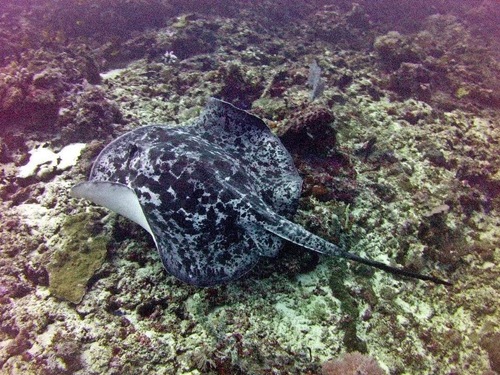
Blotched Fantail Ray (Taeniurops meyeni)
Blotched Fantail Ray Taeniurops meyeni A large, dark grey ray with a broad, rounded disc and a long, whip-like tail. It has a pattern of pale blotches and spots on its back.to 1.8 m disc width · 5-100 m · day and nightsandy areas near reefs and rocky outcropsOften rests motionless on the sand; look for its outline and the slight movement of its spiracles behind the eyes. (c) eyrezer, some rights reserved (CC BY) · observation
Reef Manta Ray (Mobula alfredi)
Reef Manta Ray Mobula alfredi A large, flat ray with a dark grey to black upper side and white underside, often with distinctive shoulder patches. It swims by flapping its wing-like pectoral fins.to 5.5 m wingspan · surface to 30 m · day and nightnear coral reefs, cleaning stations, and channelsObserve from a distance at cleaning stations; mantas will circle the area repeatedly, allowing for extended viewing. (c) Dan Bender, some rights reserved (CC BY) · observation
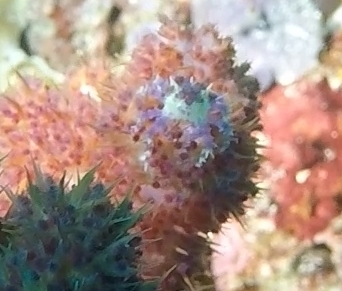
Soft Coral Crab (Hoplophrys oatesii)
Soft Coral Crab Hoplophrys oatesii A tiny, colourful crab that mimics the polyps of its host soft coral, often pink, yellow or white with matching speckles.to 2 cm · 5-30 m · day and nighton the branches of soft corals like DendronephthyaLook closely at soft coral colonies for small, slow-moving bumps that look like polyps but have legs. (c) Dan Bender, some rights reserved (CC BY) · observation
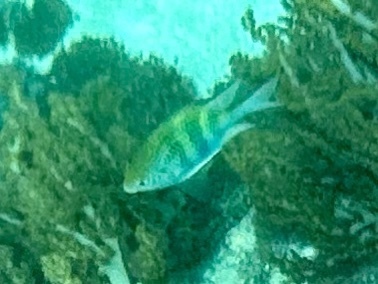
Staghorn Damsel (Amblyglyphidodon curacao)
Staghorn Damsel Amblyglyphidodon curacao A small, silvery-blue damselfish with a yellow tail, often seen hovering above branching corals.to 10 cm · 1-12 m · by daybranching corals, especially Acropora thicketsLook for individuals darting among the coral branches; they retreat into the coral when approached. (c) Rui Ribeiro, some rights reserved (CC BY) · observation
Clark's Anemonefish (Amphiprion clarkii)
Clark's Anemonefish Amphiprion clarkii A variable anemonefish, often dark brown to orange with three white bars; the tail fin may be yellow or white. It lives within the tentacles of host anemones.to 15 cm · 1-30 m · by dayhost anemones on reef slopes and lagoonsWatch for its protective behaviour; it will dart out and retreat to the anemone if approached too closely. no rights reserved · CC0 · observation
Three-striped Whiptail (Pentapodus trivittatus)
Three-striped Whiptail Pentapodus trivittatus A slender, silvery fish with three distinct dark stripes along its body, often seen swimming in small groups above the reef.to 30 cm · 5-40 m · by daycoral and rocky reefs, often over rubble or sandLook for them hovering just above the reef edge; they are easily spooked, so approach cautiously. no rights reserved · CC0 · observation
Blacklip Butterflyfish (Chaetodon kleinii)
Blacklip Butterflyfish Chaetodon kleinii A pale yellow butterflyfish with a black bar through the eye, a black spot on the dorsal fin, and a distinctive black margin on the lips.to 15 cm · 3-30 m · by daycoral-rich areas of reefs and lagoonsOften seen in pairs or small groups, moving quickly between coral heads to feed on polyps. no rights reserved · CC0 · observation