Home › Dive Sites › Indonesia › Bali › Sd Point (Sekolah Dasar)
Sd Point (Sekolah Dasar)

📍 Bali, Indonesia

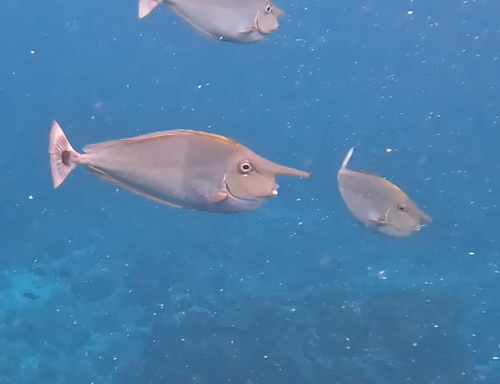
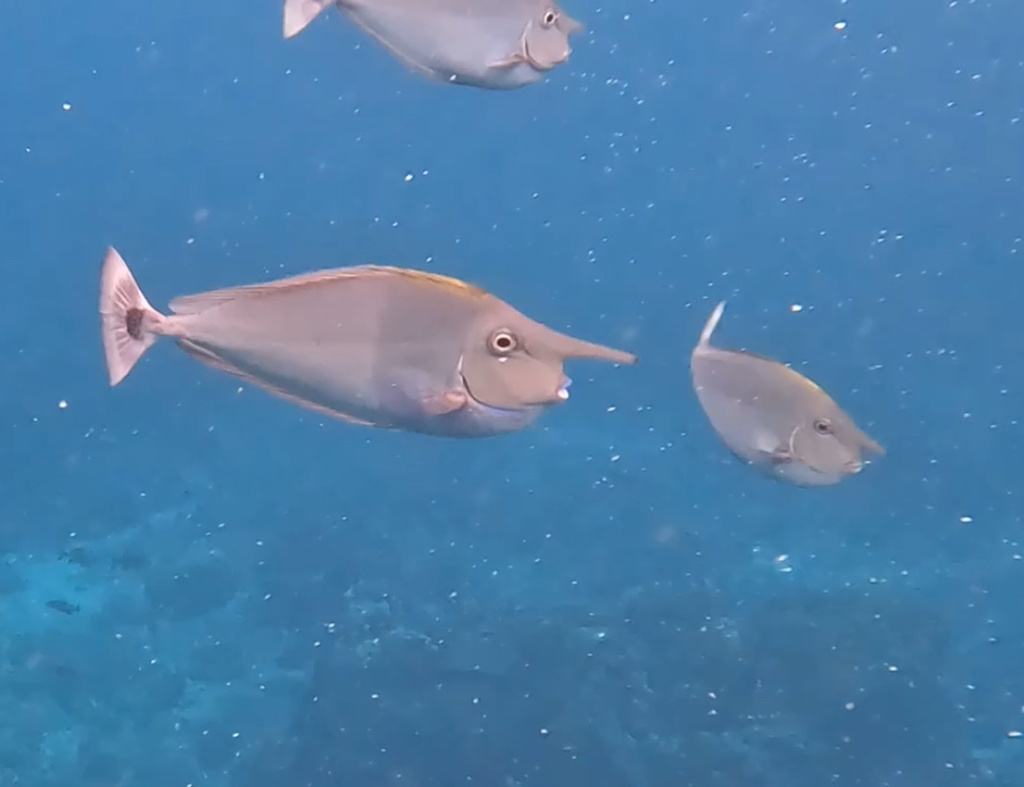
Paletail Unicornfish (Naso brevirostris) — recorded at Sd Point (Sekolah Dasar)

Sd Point (Sekolah Dasar) is a dive site in Bali, Indonesia. It lies within the Nusa Penida Marine Protected Area. Currents typically run at 2.6 km/h and reach 4.2 km/h on the strongest days. Water temperatures range from 27°C in September to 30°C in December. The typical daily tidal range is about 1.5 m. Species recorded in the area include Bump-head Mola, Paletail Unicornfish, Barred Filefish, Bicolor Cleaner Wrasse and Gold Ring Cowry.

Dive Conditions

💨
Current
2.6 km/h (4.2)
🌡️
Water Temp
27–30 °C

🤿 Book a Diving Tour in Sd Point (Sekolah Dasar)

Tours powered by GetYourGuide. FindADive may earn a commission on bookings.

Typical Current 2.6 km/h (up to 4.2)
Water Temperature 27–30 °C
Tidal Range 1.5 m (typical daily)
GPS -8.6696°, 115.5009°

Data sources: currents and water temperature from Open-Meteo Marine (CC BY 4.0), hourly model values 2024. Tidal range is the median daily range of modelled sea level from Open-Meteo Marine, hourly values 2024. Protected area boundary from OpenStreetMap contributors (ODbL). Species observations from iNaturalist, checked against the World Register of Marine Species.

Conditions at Sd Point (Sekolah Dasar) through the year

Sea surface temperature at the site coordinates, averaged per month from hourly model values for 2024. The water is warmest in December at about 30 °C and coolest in September at about 27 °C, a spread of 2.7 degrees across the year.

Monthly sea surface temperature at Sd Point (Sekolah Dasar) (°C)
JanFebMarAprMayJunJulAugSepOctNovDec
29.3 29.6 29.7 29.0 28.3 28.2 27.6 27.5 27.1 27.5 29.1 29.8

Ocean current at the site runs at a typical 2.6 km/h. In the strongest tenth of the hours modelled for 2024 it reaches 4.2 km/h, which is when entries are normally timed to slack water at the turn of the tide.

The tide moves the water level by a median 1.5 m over a day, and by up to 2.1 m on the largest days of the month. That range drives how much water is exchanged over the reef and when the current turns.

Offshore wave statistics are not shown for Sd Point (Sekolah Dasar): within 10 km of the site there is land in the directions from which 86 % of the larger waves in the area arrive, so open-sea values would overstate the swell at the site itself.

Sd Point (Sekolah Dasar) lies inside Nusa Penida Marine Protected Area. Protected areas can carry their own rules on entry fees, permits, anchoring and fishing; check the current rules with a local operator before you dive.

How Sd Point (Sekolah Dasar) compares

These comparisons use only the measured values above, set against the 376 dive sites published on findadive.com. A percentage shows the share of other sites with a lower (or higher) value, so it reads the same way wherever the site is. Sd Point (Sekolah Dasar) sits with its mean water temperature in the bottom tenth and its coolest-month water temperature in the bottom tenth of all listed sites.

Sd Point (Sekolah Dasar) compared with all listed sites and with Bali
MeasureThis siteCompared with all sitesMedian in Bali
Mean water temperature28.6 °Ccooler than 90 % of the other 375 sites29.1 °C (99 sites)
Water temperature in the coolest month27.1 °Ccooler than 90 % of the other 375 sites27.8 °C (99 sites)
Typical current2.6 km/hstronger than 78 % of the other 375 sites3.2 km/h (99 sites)
Current in the strongest 10 % of hours4.2 km/hstronger than 73 % of the other 375 sites5.7 km/h (99 sites)
Median daily tidal range1.5 mlarger than 60 % of the other 375 sites1.5 m (99 sites)

Water temperature, current and tide from Open-Meteo Marine (CC BY 4.0), hourly model values for 2024 at -8.6696°, 115.5009°. Protected area boundary from OpenStreetMap contributors (ODbL). Wave statistics from ERA5-Ocean via Open-Meteo Marine (contains modified Copernicus Climate Change Service information 2015–2024), daily maximum wave height on a 0.5° grid; land shelter tested against Natural Earth coastlines.

Marine life recorded at this site

Research-grade observations from iNaturalist within about 12 km of these coordinates.

Bump-head Mola (Mola alexandrini)
Bump-head Mola Mola alexandrini A large, disc-shaped ocean sunfish with a prominent forehead bump and rough skin texture. It often swims near the surface or rests on its side.to 3.3 m · surface to 600 m · day and nightopen ocean, sometimes near reefs or cleaning stationsLook for a large, dark shape lying motionless on its side near the surface, or watch for its dorsal fin breaking the water. (c) Kai Squires, some rights reserved (CC BY) · observation
Paletail Unicornfish (Naso brevirostris)
Paletail Unicornfish Naso brevirostris A large unicornfish with a prominent horn-like projection on the forehead, a dark body, and a distinctive white patch at the base of the tail.to 60 cm · 5-90 m · by dayouter reef slopes and channelsOften seen in small groups; look for the white tail patch and the horn when viewing from the side. (c) Nick Tobler (Cowturtle), some rights reserved (CC BY) · observation
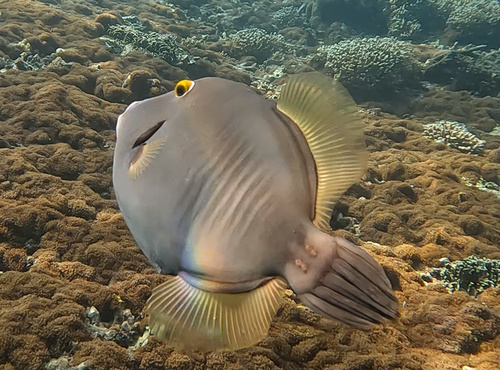
Barred Filefish (Cantherhines dumerilii)
Barred Filefish Cantherhines dumerilii A large, deep-bodied filefish with a barred pattern of dark vertical lines on a pale background. It has a small, upturned mouth and a single dorsal spine.to 38 cm · 3-40 m · by dayouter reef slopes and channels, often near coral or rubbleOften solitary. Moves slowly with undulating fins; approach gently to avoid startling it. (c) Nick Tobler (Cowturtle), some rights reserved (CC BY) · observation
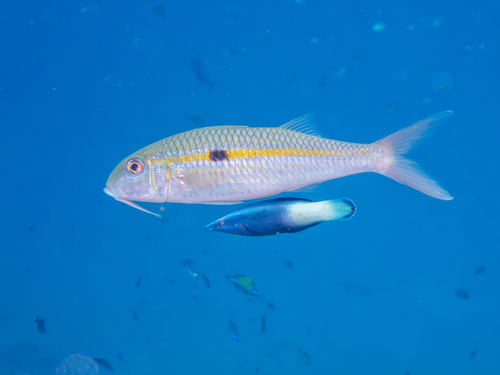
Bicolor Cleaner Wrasse (Labroides bicolor)
Bicolor Cleaner Wrasse Labroides bicolor A slender wrasse with a distinct two-tone colouration: the front half is dark blue to black, the rear half is bright yellow.to 15 cm · 1-30 m · by daycoral-rich areas of reefs, often near cleaning stationsLook for a jerky, darting swimming motion near coral heads where other fish queue to be cleaned. (c) Piotr Lukasik, some rights reserved (CC BY) · observation
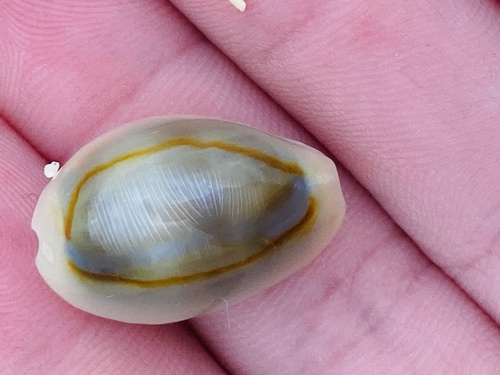
Gold Ring Cowry (Monetaria annulus)
Gold Ring Cowry Monetaria annulus A glossy, egg-shaped sea snail with a porcelain-like shell, often seen with its mantle extended, covering the shell with a brown, speckled tissue.shell to 4 cm · intertidal to 20 m · at nightcoral reef flats and rubble, often under ledgesLook for its extended mantle at night; by day, it often hides in crevices with the mantle retracted. (c) River Ahlquist, some rights reserved (CC BY) · observation
Orangestripe Triggerfish (Balistapus undulatus)
Orangestripe Triggerfish Balistapus undulatus A medium-sized triggerfish with a dark greenish body covered in wavy orange lines, a white tail base and a distinctive orange stripe from mouth to pectoral fin.to 30 cm · 1-50 m · by daycoral-rich areas of reefs and lagoonsOften seen foraging alone; can be aggressive when guarding a nest, which is a cleared patch on the sand. (c) River Ahlquist, some rights reserved (CC BY) · observation
Whitecheek Surgeonfish (Acanthurus nigricans)
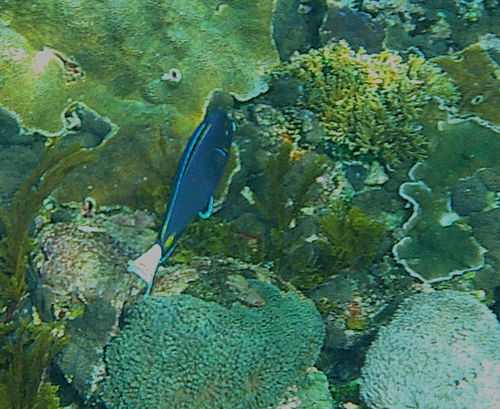
Whitecheek Surgeonfish Acanthurus nigricans A dark brown surgeonfish with a distinctive white patch below the eye and a yellow band at the base of the pectoral fin.to 21 cm · 1-67 m · by daycoral-rich areas of clear lagoon and seaward reefsOften seen singly or in small groups grazing on algae; look for the bright white cheek patch. (c) River Ahlquist, some rights reserved (CC BY) · observation
Clown Triggerfish (Balistoides conspicillum)
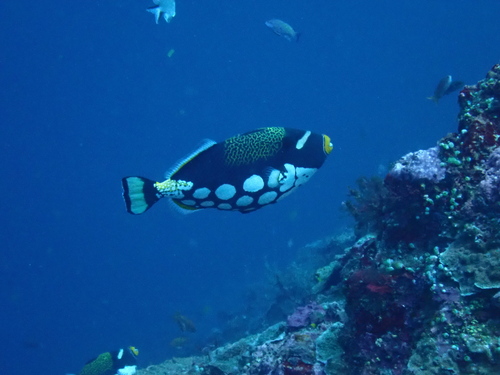
Clown Triggerfish Balistoides conspicillum A bold triggerfish with a black body, large white spots on the lower half, and a bright yellow mouth and fin markings.to 50 cm · 1-75 m · by dayreef slopes and drop-offs, often near cavesObserve from a distance; it can be territorial and will often retreat into a crevice if approached too closely. (c) Austen Novis, some rights reserved (CC BY) · observation