Home › Dive Sites › Indonesia › Bali › Batu Meling

Batu Meling

📍 Bali, Indonesia

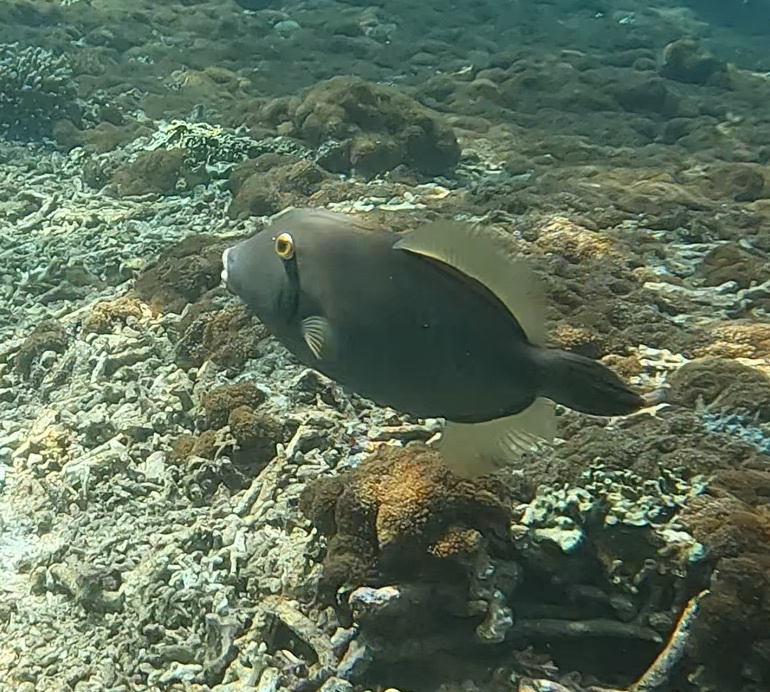
Barred Filefish (Cantherhines dumerilii) — recorded at Batu Meling

Batu Meling is a dive site in Bali, Indonesia. It lies within the Nusa Penida Marine Protected Area. Currents typically run at 1.1 km/h and reach 2.7 km/h on the strongest days. Water temperatures range from 27°C in August to 30°C in December. The typical daily tidal range is about 1.8 m. Species recorded in the area include Barred Filefish, Reef Manta Ray, Sixline Wrasse, Dusky Nembrotha and Titan Triggerfish.

Dive Conditions

💨
Current
1.1 km/h (2.7)
🌡️
Water Temp
27–30 °C

🤿 Book a Diving Tour in Batu Meling

Tours powered by GetYourGuide. FindADive may earn a commission on bookings.

Typical Current 1.1 km/h (up to 2.7)
Water Temperature 27–30 °C
Tidal Range 1.8 m (typical daily)
GPS -8.7742°, 115.4933°

Data sources: currents and water temperature from Open-Meteo Marine (CC BY 4.0), hourly model values 2024. Tidal range is the median daily range of modelled sea level from Open-Meteo Marine, hourly values 2024. Protected area boundary from OpenStreetMap contributors (ODbL). Species observations from iNaturalist, checked against the World Register of Marine Species.

Conditions at Batu Meling through the year

Sea surface temperature at the site coordinates, averaged per month from hourly model values for 2024. The water is warmest in December at about 30 °C and coolest in August at about 27 °C, a spread of 3.2 degrees across the year.

Monthly sea surface temperature at Batu Meling (°C)
JanFebMarAprMayJunJulAugSepOctNovDec
29.2 29.6 29.6 29.1 28.2 28.0 27.1 26.7 26.9 27.5 29.2 29.9

Ocean current at the site runs at a typical 1.1 km/h. In the strongest tenth of the hours modelled for 2024 it reaches 2.7 km/h, which is when entries are normally timed to slack water at the turn of the tide.

The tide moves the water level by a median 1.8 m over a day, and by up to 2.5 m on the largest days of the month. That range drives how much water is exchanged over the reef and when the current turns.

In the open sea off Batu Meling, the highest wave of the day exceeded 1.5 m on 79.8 % of days between 2015 and 2024. The roughest month was July (99 % of days), the calmest March (54 %).

Share of days with waves above 1.5 m, open sea near Batu Meling (%, 2015–2024)
JanFebMarAprMayJunJulAugSepOctNovDec
776954719394999893855767

Batu Meling lies inside Nusa Penida Marine Protected Area. Protected areas can carry their own rules on entry fees, permits, anchoring and fishing; check the current rules with a local operator before you dive.

How Batu Meling compares

These comparisons use only the measured values above, set against the 376 dive sites published on findadive.com. A percentage shows the share of other sites with a lower (or higher) value, so it reads the same way wherever the site is. Batu Meling sits with its mean water temperature in the bottom tenth and its coolest-month water temperature in the bottom tenth of all listed sites.

Batu Meling compared with all listed sites and with Bali
MeasureThis siteCompared with all sitesMedian in Bali
Mean water temperature28.4 °Ccooler than 94 % of the other 375 sites29.1 °C (99 sites)
Water temperature in the coolest month26.7 °Ccooler than 92 % of the other 375 sites27.8 °C (99 sites)
Typical current1.1 km/hstronger than 50 % of the other 375 sites3.2 km/h (99 sites)
Current in the strongest 10 % of hours2.7 km/hstronger than 54 % of the other 375 sites5.7 km/h (99 sites)
Median daily tidal range1.8 mlarger than 79 % of the other 375 sites1.5 m (99 sites)

Water temperature, current and tide from Open-Meteo Marine (CC BY 4.0), hourly model values for 2024 at -8.7742°, 115.4933°. Protected area boundary from OpenStreetMap contributors (ODbL). Wave statistics from ERA5-Ocean via Open-Meteo Marine (contains modified Copernicus Climate Change Service information 2015–2024), daily maximum wave height on a 0.5° grid; land shelter tested against Natural Earth coastlines.

Marine life recorded at this site

Research-grade observations from iNaturalist within about 12 km of these coordinates.
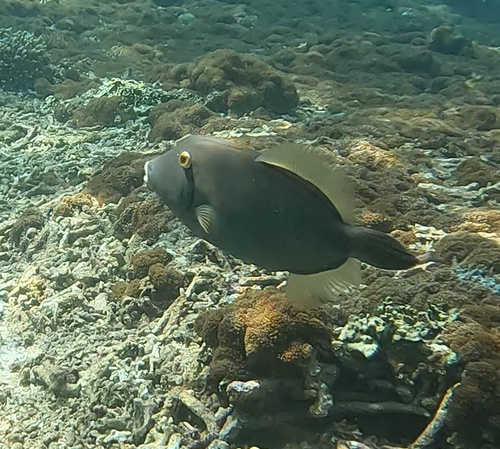
Barred Filefish (Cantherhines dumerilii)
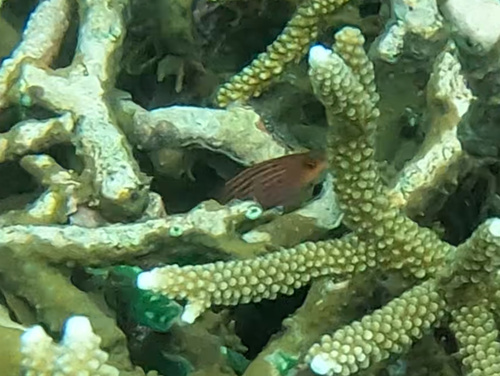
Barred Filefish Cantherhines dumerilii A large, deep-bodied filefish with a barred pattern of dark vertical lines on a pale background. It has a small, upturned mouth and a single dorsal spine.to 38 cm · 3-40 m · by dayouter reef slopes and channels, often near coral or rubbleOften solitary. Moves slowly with undulating fins; approach gently to avoid startling it. (c) Nick Tobler (Cowturtle), some rights reserved (CC BY) · observation
Reef Manta Ray (Mobula alfredi)
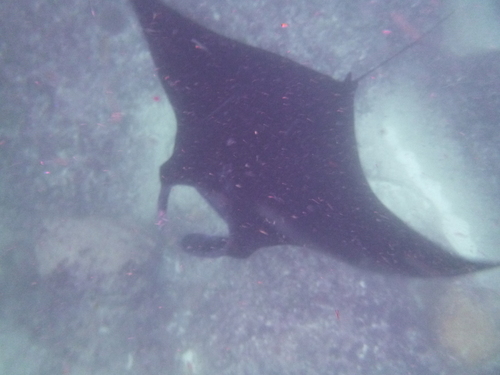
Reef Manta Ray Mobula alfredi A large, flat ray with a dark grey to black upper side and white underside, often with distinctive shoulder patches. It swims by flapping its wing-like pectoral fins.to 5.5 m wingspan · surface to 30 m · day and nightnear coral reefs, cleaning stations, and channelsObserve from a distance at cleaning stations; mantas will circle the area repeatedly, allowing for extended viewing. no rights reserved · CC0 · observation
Sixline Wrasse (Pseudocheilinus hexataenia)
Sixline Wrasse Pseudocheilinus hexataenia A small, slender wrasse with six horizontal blue lines on an orange body, constantly darting among coral branches.to 10 cm · 2-35 m · by daydense coral branches and rubble on outer reef slopesLook for its quick, jerky movements in coral thickets; it often retreats into crevices if approached. (c) Nick Tobler (Cowturtle), some rights reserved (CC BY) · observation
Dusky Nembrotha (Nembrotha kubaryana)
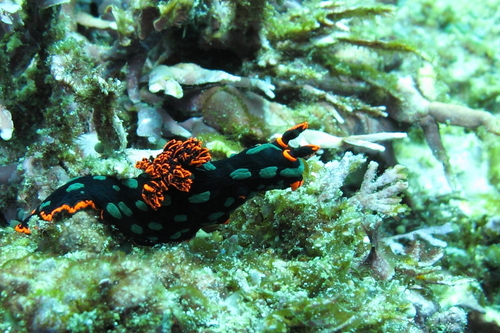
Dusky Nembrotha Nembrotha kubaryana A large, dark-bodied nudibranch with bright green or yellow markings along its back and sides. It has a pair of black rhinophores and gills.to 12 cm · 5-30 m · day and nightcoral and rocky reefs, often near its food sourceLook for it crawling on sponges, particularly the green sponge it feeds on, which can help locate it. (c) Bart, some rights reserved (CC BY) · observation
Titan Triggerfish (Balistoides viridescens)
Titan Triggerfish Balistoides viridescens A large, robust triggerfish with a dark body, pale greenish-grey face and a black mask. It is territorial, especially when nesting.to 75 cm · 1-50 m · by dayouter reef slopes and lagoonsGive nesting fish a wide berth; it will defend its cone-shaped nest on the sand aggressively. (c) Eric Knight, some rights reserved (CC BY) · observation
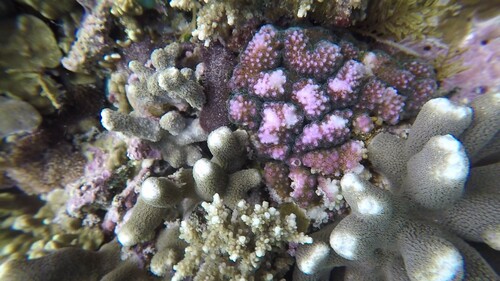
Cauliflower Coral (Pocillopora verrucosa)
Cauliflower Coral Pocillopora verrucosa A branching stony coral with short, thick, wart-like branches that form dense, rounded colonies, often pale brown or green.colonies to 1 m across · 3-20 mreef slopes and lagoons, often in areas with moderate water movementLook for its distinctive lumpy branches, which provide shelter for many small fish and crustaceans. (c) Eric Knight, some rights reserved (CC BY) · observation
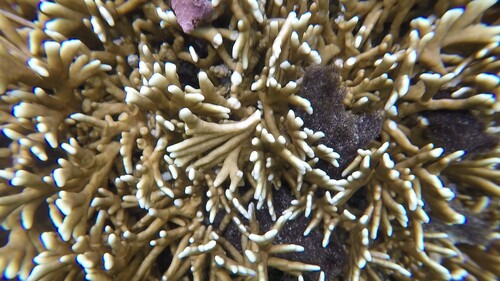
Millepora tenera (Millepora tenera)
Millepora tenera Millepora tenera A branching fire coral with smooth, slender branches that appear yellow-brown. It delivers a painful sting on contact.colonies to 60 cm · 1-25 m · day and nightshallow reef crests and upper slopesMaintain neutral buoyancy and avoid touching; the sting is immediate and can cause a rash. (c) Eric Knight, some rights reserved (CC BY) · observation
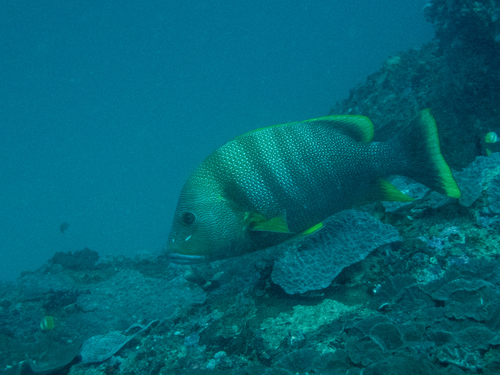
Speckled Snapper (Lutjanus rivulatus)
Speckled Snapper Lutjanus rivulatus A large, robust snapper with a brownish body densely covered in small blue spots, and a pale belly. Adults often have a dark band through the eye.to 80 cm · 5-100 m · day and nightcoral and rocky reefs, often near overhangs or drop-offsOften seen in small groups hovering near the reef. Look for the distinctive blue spots, which are more obvious on larger individuals. (c) Piotr Lukasik, some rights reserved (CC BY) · observation