Home › Dive Sites › Thailand › Koh Tao › Hin Wong Bay

Hin Wong Bay

📍 Koh Tao, Thailand

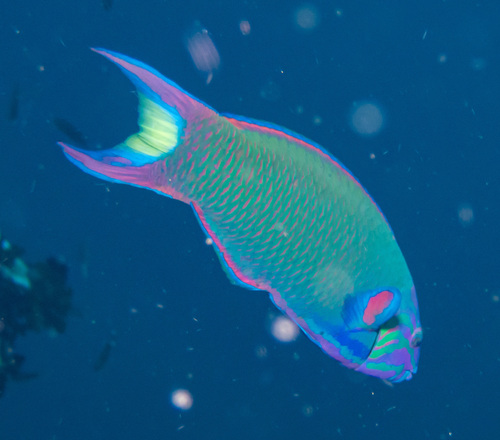
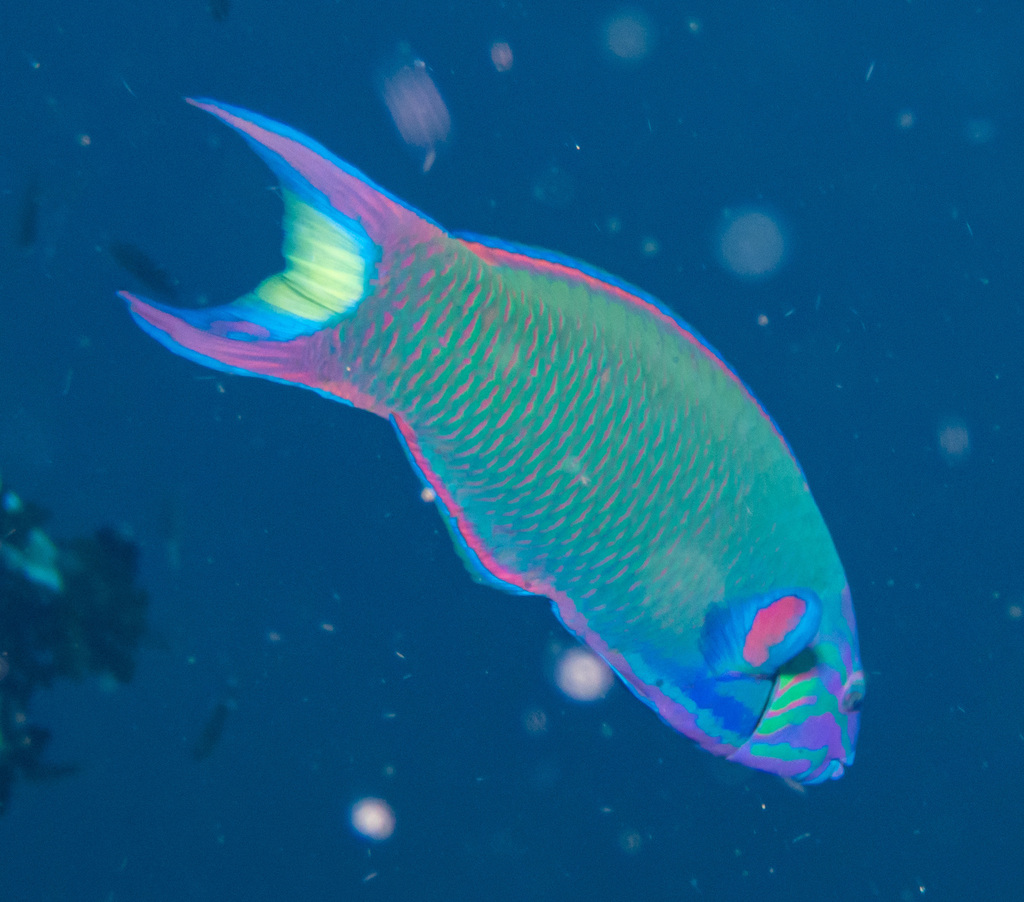
Moon Wrasse (Thalassoma lunare) — recorded at Hin Wong Bay

Hin Wong Bay is a dive site in Koh Tao, Thailand. Currents typically run at 0.6 km/h and reach 1.2 km/h on the strongest days. Water temperatures range from 28°C in January to 31°C in May. The typical daily tidal range is about 1.3 m. Species recorded in the area include Wire Coral Crab, Shoulderspot Wrasse, Moon Wrasse, Bluespotted Fantail Ray and Doublebar Rabbitfish.

Dive Conditions

💨
Current
0.6 km/h (1.2)
🌡️
Water Temp
28–31 °C

🤿 Book a Diving Tour in Hin Wong Bay

Tours powered by GetYourGuide. FindADive may earn a commission on bookings.

Typical Current 0.6 km/h (up to 1.2)
Water Temperature 28–31 °C
Tidal Range 1.3 m (typical daily)
GPS 10.1023°, 99.8510°

Data sources: currents and water temperature from Open-Meteo Marine (CC BY 4.0), hourly model values 2024. Tidal range is the median daily range of modelled sea level from Open-Meteo Marine, hourly values 2024. Species observations from iNaturalist, checked against the World Register of Marine Species.

Conditions at Hin Wong Bay through the year

Sea surface temperature at the site coordinates, averaged per month from hourly model values for 2024. The water is warmest in May at about 31 °C and coolest in January at about 28 °C, a spread of 3.3 degrees across the year.

Monthly sea surface temperature at Hin Wong Bay (°C)
JanFebMarAprMayJunJulAugSepOctNovDec
28.1 28.7 29.2 30.8 31.4 30.4 30.1 30.0 29.7 29.9 29.5 28.5

Ocean current at the site runs at a typical 0.6 km/h. In the strongest tenth of the hours modelled for 2024 it reaches 1.2 km/h, which is when entries are normally timed to slack water at the turn of the tide.

The tide moves the water level by a median 1.3 m over a day, and by up to 1.7 m on the largest days of the month. That range drives how much water is exchanged over the reef and when the current turns.

In the open sea off Hin Wong Bay, the highest wave of the day exceeded 1.5 m on 3.2 % of days between 2015 and 2024. The roughest month was December (13 % of days), the calmest March (0 %).

Share of days with waves above 1.5 m, open sea near Hin Wong Bay (%, 2015–2024)
JanFebMarAprMayJunJulAugSepOctNovDec
8201012231513

Satellite habitat mapping places Hin Wong Bay on an outer reef slope, over a seabed mapped as coral and algae. The classification comes from the nearest mapped reef polygon, about 25 m from the listed coordinates, so it describes the reef the site sits on rather than a single point on it.

How Hin Wong Bay compares

These comparisons use only the measured values above, set against the 376 dive sites published on findadive.com. A percentage shows the share of other sites with a lower (or higher) value, so it reads the same way wherever the site is.

Hin Wong Bay compared with all listed sites and with Koh Tao
MeasureThis siteCompared with all sitesMedian in Koh Tao
Mean water temperature29.7 °Cwarmer than 71 % of the other 375 sites29.7 °C (34 sites)
Water temperature in the coolest month28.1 °Ccooler than 54 % of the other 375 sites28.1 °C (34 sites)
Typical current0.6 km/hweaker than 88 % of the other 375 sites0.6 km/h (34 sites)
Current in the strongest 10 % of hours1.2 km/hweaker than 86 % of the other 375 sites1.2 km/h (34 sites)
Median daily tidal range1.3 msmaller than 69 % of the other 375 sites1.3 m (34 sites)

Water temperature, current and tide from Open-Meteo Marine (CC BY 4.0), hourly model values for 2024 at 10.1023°, 99.8510°. Wave statistics from ERA5-Ocean via Open-Meteo Marine (contains modified Copernicus Climate Change Service information 2015–2024), daily maximum wave height on a 0.5° grid; land shelter tested against Natural Earth coastlines. Reef structure and seabed cover from the Allen Coral Atlas © 2018–2023 Allen Coral Atlas Partnership and Arizona State University (CC BY 4.0).

Marine life recorded at this site

Research-grade observations from iNaturalist within about 12 km of these coordinates.
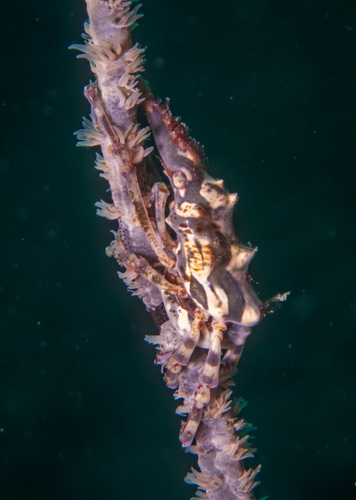
Wire Coral Crab (Xenocarcinus tuberculatus)
Wire Coral Crab Xenocarcinus tuberculatus A small, decorator crab that attaches bits of wire coral and other debris to its body for camouflage, making it look like a moving piece of coral.to 2 cm carapace · 10-40 m · day and nighton wire corals and gorgoniansLook for movement on wire coral branches; the crab's legs and body are often completely obscured by its camouflage. (c) portioid, some rights reserved (CC BY) · observation
Shoulderspot Wrasse (Leptojulis cyanopleura)
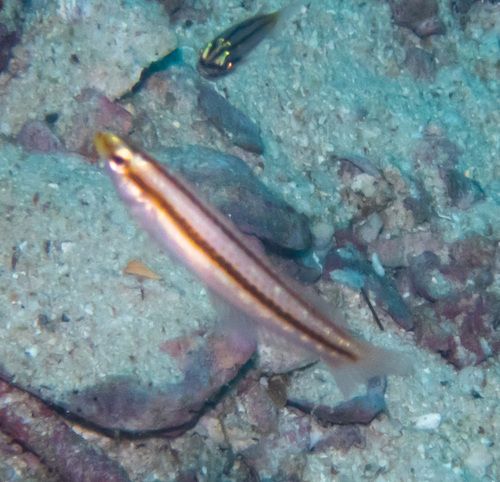
Shoulderspot Wrasse Leptojulis cyanopleura A slender wrasse with a pale body and a distinctive dark blue or black spot on the upper side just behind the gill cover.to 13 cm · 2-25 m · by daysandy areas near coral or rubble patchesWatch for it hovering just above the sand, darting down to feed; it often returns to the same spot. (c) portioid, some rights reserved (CC BY) · observation
Moon Wrasse (Thalassoma lunare)
Moon Wrasse Thalassoma lunare A colourful wrasse with a bright yellow crescent on the tail base, often seen swimming actively above the reef.to 45 cm · 1-20 m · by daycoral-rich areas of lagoons and seaward reefsWatch for its constant movement; it often darts into the water column to feed on plankton. (c) portioid, some rights reserved (CC BY) · observation
Bluespotted Fantail Ray (Taeniura lymma)
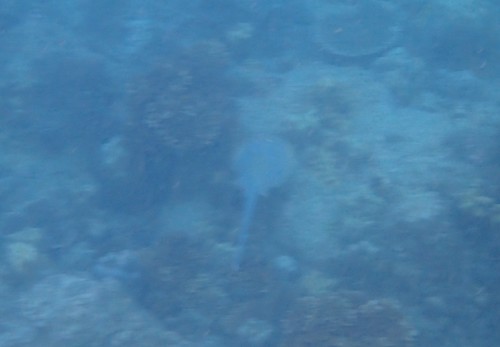
Bluespotted Fantail Ray Taeniura lymma A small, colourful ray with a rounded disc and a short tail, marked by vivid blue spots on a yellowish-brown background.to 35 cm disc width · 1-20 m · day and nightsandy patches near coral reefs and rubbleLook for its shape partly buried in sand during the day; it often flushes from cover if approached too closely. (c) luluchouette, some rights reserved (CC BY) · observation
Doublebar Rabbitfish (Siganus virgatus)
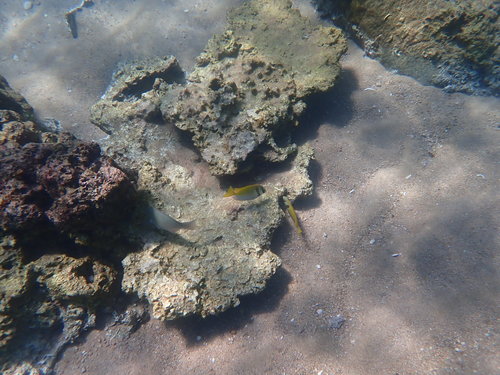
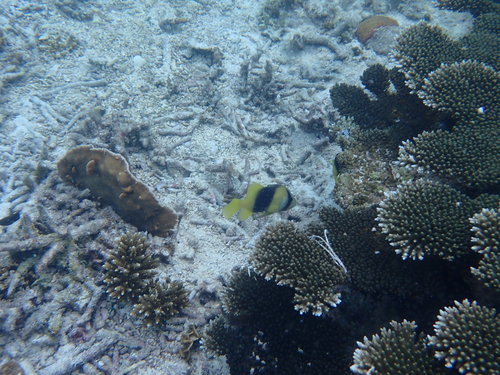
Doublebar Rabbitfish Siganus virgatus A pale yellow rabbitfish with two dark brown vertical bars, one through the eye and one behind the pectoral fin, and numerous small blue spots on the head and body.to 30 cm · 1-25 m · by daycoral-rich areas of lagoons and seaward reefsOften seen in pairs grazing on algae; look for them near branching corals and outcrops. (c) luluchouette, some rights reserved (CC BY) · observation
Barred Soapfish (Diploprion bifasciatus)
Barred Soapfish Diploprion bifasciatus A bright yellow fish with two broad black vertical bars, one through the eye and one behind the pectoral fin. It often hovers motionless.to 25 cm · 5-40 m · day and nightcaves, ledges, and overhangs on coral reefsLook for a solitary, still yellow shape in the shadows of reef structures; it may retreat if approached directly. (c) luluchouette, some rights reserved (CC BY) · observation
Bluestreak Cleaner Wrasse (Labroides dimidiatus)
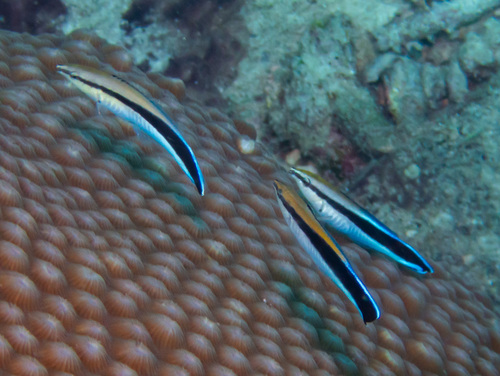
Bluestreak Cleaner Wrasse Labroides dimidiatus A small, slender wrasse with a distinctive black lateral stripe that runs from snout to tail, bordered by electric blue above. It performs cleaning services for other fish.to 14 cm · 1-40 m · by daycoral-rich areas of reef, often at established cleaning stationsLook for a queue of larger fish hovering motionless; the wrasse will be darting in and out of their gills and mouths. (c) portioid, some rights reserved (CC BY) · observation
Whitetail Damsel (Pomacentrus chrysurus)
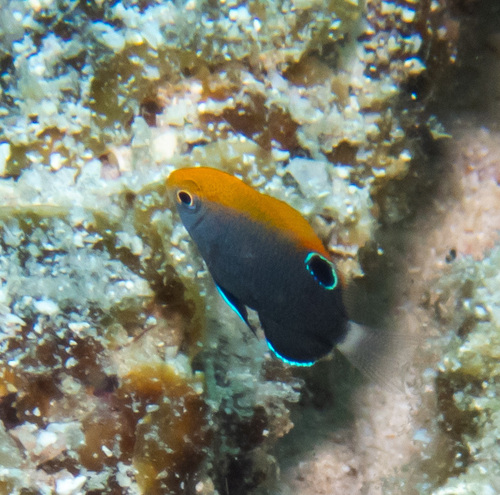
Whitetail Damsel Pomacentrus chrysurus A small, dark-bodied damselfish with a distinctive white tail and a yellow-edged dorsal fin. It is territorial and often seen darting near coral.to 9 cm · 1-12 m · by daycoral-rich areas of lagoons and outer reefsLook for it hovering just above branching corals, which it uses for shelter when threatened. (c) portioid, some rights reserved (CC BY) · observation