Home › Dive Schools › Indonesia › Nusa Penida › Dune Penida

Dune Penida

PADI 5 Star IDC Resort 📍 Nusa Penida, Indonesia ★★★★★ 5.0 (1,705 reviews)

Photo: no rights reserved · CC0 · via iNaturalist

Dune Penida is a PADI 5 Star IDC Resort in Nusa Penida, Indonesia. It is based at Unnamed Road No.80771, Sakti, Kec. Nusa Penida, Kabupaten Klungkung, Bali 80771, Indonesia.

On Google it holds an average rating of 5.0 from 1705 reviews.

Sea temperatures in the surrounding waters range from 27°C in September to 30°C in December. Species recorded near these coordinates include Reef Manta Ray, Onespot Snapper, Blacklip Butterflyfish and Teardrop Butterflyfish.

🤿 Book a Diving Tour in Nusa Penida, Indonesia

Tours powered by GetYourGuide. FindADive may earn a commission on bookings.

At a glance

  • One of 2 PADI centres listed in Nusa Penida (5 dive centres there in total)
  • 6 dive sites within 60 km: Toyapakeh Wall And Scope (1 km) · Ceningan Wall (2 km) · Ceningan Channel (2 km) · Gamat Bay (2 km) · Sd Point (Sekolah Dasar) (3 km) · Mangrove Point (3 km)
Certification PADI 5 Star IDC Resort
Location Nusa Penida, Indonesia
Address Unnamed Road No.80771, Sakti, Kec. Nusa Penida, Kabupaten Klungkung, Bali 80771, Indonesia
Google Rating ★★★★★ 5.0 1,705 reviews
GPS -8.6848°, 115.4833°
Operator ID 1e541a2f-9c6d-42da-b0db-9d2688509f5f

Sea temperature through the year

Average sea surface temperature at the coordinates of Dune Penida, Nusa Penida, Indonesia, by calendar month. The water is warmest in December at 29.8 °C and coldest in September at 27.1 °C, a spread of 2.7 kelvin over the year. Every month of the year averages 25 °C or more.

MonthJanFebMarAprMayJunJulAugSepOctNovDec
Sea temperature (°C)29.329.629.729.028.328.227.627.527.127.529.129.8

By season, the four quarterly averages at this location are spring (March to May) 29.0 °C, summer (June to August) 27.8 °C, autumn (September to November) 27.9 °C and winter (December to February) 29.6 °C.

Sea surface temperature from Open-Meteo Marine (CC BY 4.0), daily model means 2022-11 to 2024-12, sampled at the coordinates of this dive centre. Values are monthly averages of the daily means, not forecasts.

Marine life recorded in this area

Research-grade observations from iNaturalist near these coordinates.
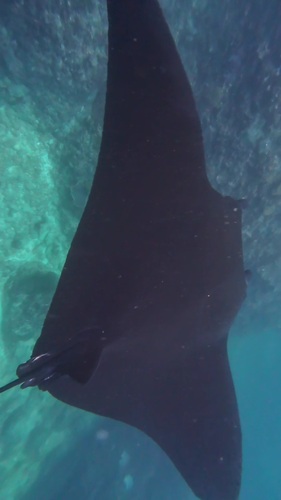
Reef Manta Ray (Mobula alfredi)
Reef Manta Ray Mobula alfredi A large, flat ray with a dark grey to black upper side and white underside, often with distinctive shoulder patches. It swims by flapping its wing-like pectoral fins.to 5.5 m wingspan · surface to 30 m · day and nightnear coral reefs, cleaning stations, and channelsObserve from a distance at cleaning stations; mantas will circle the area repeatedly, allowing for extended viewing. no rights reserved · CC0 · observation
Onespot Snapper (Lutjanus monostigma)
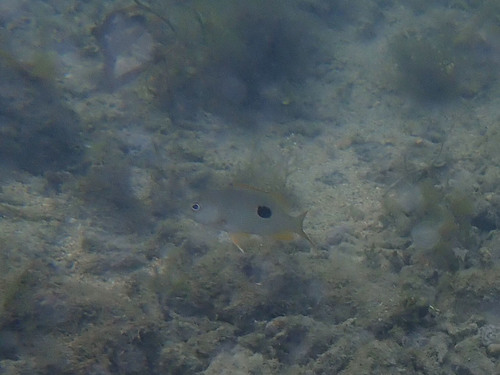
Onespot Snapper Lutjanus monostigma A silvery-pink snapper with a distinct black spot on its upper flank, often seen in small groups.to 60 cm · 3-50 m · day and nightcoral and rocky reefs, sometimes near drop-offsLook for the single dark spot on its side, which is most visible on adults; juveniles may have a less distinct spot. (c) Franz Anthony, some rights reserved (CC BY) · observation
Blacklip Butterflyfish (Chaetodon kleinii)
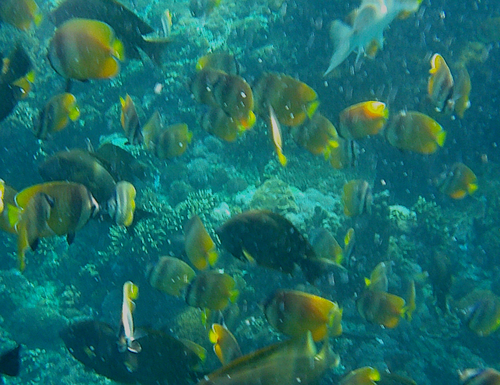
Blacklip Butterflyfish Chaetodon kleinii A pale yellow butterflyfish with a black bar through the eye, a black spot on the dorsal fin, and a distinctive black margin on the lips.to 15 cm · 3-30 m · by daycoral-rich areas of reefs and lagoonsOften seen in pairs or small groups, moving quickly between coral heads to feed on polyps. (c) River Ahlquist, some rights reserved (CC BY) · observation
Teardrop Butterflyfish (Chaetodon unimaculatus)
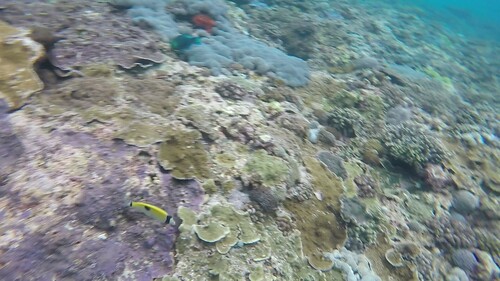
Teardrop Butterflyfish Chaetodon unimaculatus A pale yellow butterflyfish with a single large black spot on its side, a black vertical bar through the eye, and a black-edged tail.to 20 cm · 1-30 m · by daycoral-rich areas of reefs and lagoonsOften seen in pairs; look for them near branching corals where they feed on coral polyps. (c) Eric Knight, some rights reserved (CC BY) · observation